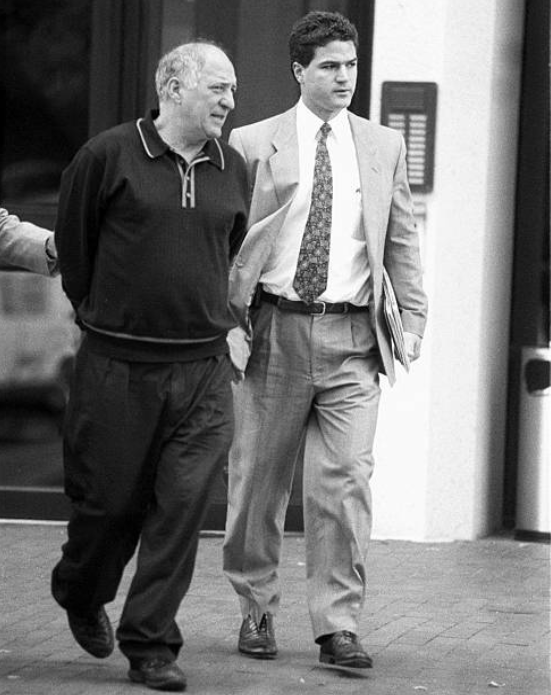
The 91-year-old incarcerated mobster, whose been behind bars for more than 30 years after being convicted as a leader of the Genovese crime family and who put out a hit on John Gotti, is making another push to be released from federal prison.
In
an emergency motion filed last month seeking compassionate release for
Louis “Bobby” Manna, his attorney argued that the aging mobster is
slowly dying in a Minnesota medical prison and deserves to spend the
rest of his life with his family in Hudson County.
Manna
has a “litany of health issues,” Jeremy Iandolo, Manna’s attorney, said
during a hearing before a federal judge Thursday, including
hypertension and Parkinson’s disease. He can no longer take more than a
step or two on his own, the attorney said.
“After 33 years (in prison), the man has paid his debt to society,” said Iandolo, of Brooklyn.
Manna previously applied for compassionate release last year — a motion that was opposed by prosecutors and eventually denied by senior U.S. District Judge Peter G. Sheridan.
Manna
is in the midst of an 80-year prison sentence after being convicted in
1989 in New Jersey federal court for his role as the consigliere of the
Genovese crime family, as well as placing a hit on mob boss John Gotti
and his brother, Gene Gotti, and orchestrating the murder of a crime
family associate. Also known as “The Thin Guy,” Manna was seen as one of
the most experienced and powerful mob leaders in the country at the
time, prosecutors said.
“Manna
was a leader in the Genovese family, a street boss, who accomplished
(La Cosa Nostra) goals through violence and intimidation,” Judge
Sheridan wrote last year when he denied Manna’s motion for compassionate
release. “Despite the fact that he is considered ‘frail’ and has some
medical issues, the nature of his life as a career criminal and his
leadership in the Genovese family outweigh his age and medical issues.”
Sheridan heard arguments Thursday on the latest motion and said he would have a ruling in a week or two.
Manna,
who turns 92 in less than a month, was on the telephone for the court
hearing Thursday. When asked if he wanted to address the court, Manna
struggled to speak and said he would let his attorney speak for him.
Iandolo’s
argument for Manna’s release centered around his deteriorating health,
but also recent prisoners with similar circumstances to Manna who were
freed by federal judges under compassionate release.
The attorney pointed to Eddie David Cox, an 86-year-old former Kansas City mob leader who was released from prison due to the COVID-19 pandemic after more than three decades in prison. Cox was also serving an 80-year sentence.
Iandolo
also noted that William Underwood, the leader of a 1970s Harlem heroin
trafficking gang who was serving a life sentence, was released by a judge in January. Criminal justice advocates had been pushing for the release of the 67-year-old.
“Why are only Italian Americans getting denied?” Iandolo asked after the hearing Thursday.
Assistant
U.S. Attorney Alexander Ramey told the judge he should stick with his
ruling last year in denying Manna compassionate release.
Prosecutors,
who have acknowledged that Manna is no longer a threat to society,
previously argued that he should remain incarcerated as a deterrence to
others. They have remained steadfast that he should serve the sentence
he was given, which was to “spend the remainder of his natural life in
prison,” prosecutors wrote last year.
Federal
authorities once described Manna as “dangerous and evil” and touted his
conviction as being a “tremendous blow to organized crime in New
Jersey.”
A breakdown of the Genovese crime family faction in New Jersey in the 1980s, according to the FBI.
During
the three-and-a-half month trial in the late 1980s, prosecutors
outlined Manna’s role in overseeing gambling, loansharking, and labor
racketeering in the region. When federal authorities were able to bug an
Italian restaurant in Hoboken, they learned Manna was using his power
to take out his enemies.
They
learned that he had ordered the 1987 hit on Irwin “The Fat Man” Schiff
at a Manhattan restaurant. Manna and other Genovese figures believed
Schiff was going to expose their criminal enterprise and would no longer
run a more than $25 million money laundering operation for the crime
family, according to court documents.
But
Manna was planning something even more drastic. Authorities heard Manna
select the individuals who were to participate in the “big hit” on
Gotti, according to court documents.
“Well we are stuck behind Gotti,” Manna said. “Let’s hit the (expletive).”
A subordinate of Manna’s made it clear: “The f---in’' godfather ain’t getting’ home,” he said, according to court documents.
But
federal authorities quickly foiled the plot when they alerted Gotti to
the hit, and Manna was then charged in 1988 with crimes that would put
him behind bars for decades to come.
Even
in custody, Manna was so feared that the court used an anonymous jury,
the first time ever in federal court in New Jersey at the time, due to
the fear of retaliation for the jurors, according to news reports at the
time.
But
more than 30 years later, Iandolo has repeatedly argued that Manna is
no longer a threat to society and deserves to be released as “his life
is nearing the end.”
Iandolo said Manna would live with his stepson in Bayonne if the judge grants his release.
“(He
wants to) have the rest of his time to spend with his children,
grandchildren and any family that is still alive,” the attorney said.
He
was one of the most infamous criminals ever to be killed behind bars.
And investigators narrowed in on suspects immediately after his shocking
slaying in a West Virginia prison.
Yet
three years later, no one has been charged in the beating death of
murderous Boston crime boss James “Whitey” Bulger. Questions such as why
the well-known FBI informant was put in the troubled lockup’s general
population alongside other New England gangsters — instead of more
protective housing — remain unanswered.
Federal
officials will say only that his death remains under investigation.
Meanwhile, the lack of answers has only fueled rumors and spurred claims
by Bulger’s family that the frail 89-year-old was “deliberately sent to
his death” at the penitentiary nicknamed “Misery Mountain.”
“This
was really a dereliction of duty,” said Joe Rojas, a union
representative for the correctional staff at the Florida prison where
Bulger was held before being transferred to USP Hazelton in Bruceton
Mills, West Virginia. “There’s no way he should have been put in that
institution.”
Some of the families of Bulger’s victims, however, feel differently.
Steven
Davis said holding someone accountable in the killing of the man
accused of strangling to death his 26-year-old sister, Debra Davis, in
1981 doesn’t change anything for him and other families.
“He
had what was coming to him and it didn’t come soon enough,” the
64-year-old Boston-area resident said. “He’s where he should have been a
long time ago — in the dirt.”
Bulger
was found dead on Oct. 30, 2018, hours after arriving at Hazelton from
the Coleman prison in Florida, where he was serving a life sentence for
participating in 11 killings. The ruthless gangster who spent 16 years
on the lam before being captured in 2011 was assaulted and died of blunt
force injuries to the head, according to his death certificate.
Federal
officials have never officially publicly identified any suspects and
have said only that they are investigating his death as a homicide.
But
shortly after the killing, a former federal investigator and a law
enforcement official who insisted on anonymity because of the ongoing
probe identified two Massachusetts organized crime figures as suspects:
Fotios “Freddy” Geas and Paul J. DeCologero.
Geas,
a Mafia hitman serving life behind bars for his role in the killing of a
Genovese crime family boss and other violent crimes, has been in a
restricted unit at the West Virginia prison since Bulger’s killing even
though no charges have been filed, said his lawyer, Daniel Kelly.
Kelly
says Geas hasn’t been provided regular reviews to see if he can be
released from the unit but has petitioned to be returned to the general
prison population, where he’d enjoy more freedoms, including the ability
to call his family more often.
“He’s remaining positive and upbeat, but it’s a punitive measure,” Kelly said. “It’s a prison within a prison.”
DeCologero,
meanwhile, was moved earlier this year to another high-security
penitentiary in Virginia. A member of a Massachusetts gang led by his
uncle, DeCologero was convicted in 2006 of racketeering and witness
tampering for a number of crimes and is scheduled to be released in
2026.
Brian
Kelly, one of the federal prosecutors in Bulger’s 2013 murder trial in
Boston, said the delays may indicate prison officials don’t have any
witnesses or video evidence to support charges.
“In
a prison environment they are going to have a tough time finding any
witnesses to testify as to who did it,” said Kelly, now a defense
attorney.
A
spokesperson for the federal prosecutors’ office in West Virginia
that’s investigating Bulger’s killing along with the FBI confirmed this
month that the investigation remains open. The spokesperson, Stacy
Bishop, refused to answer further questions, saying doing so could
jeopardize the probe.
Bulger’s
transfer to Hazelton — where workers had already been sounding the
alarm about violence and understaffing — and placement within the
general population despite his notoriety was widely criticized by
observers after his killing.
A
federal law enforcement official told The Associated Press in 2018 that
Bulger had been transferred to Hazelton because of disciplinary issues.
Months before he was moved, Bulger threatened an assistant supervisor
at Coleman, telling her “your day of reckoning is coming,” and received
30 days in disciplinary detention.
Some
answers may come in a federal lawsuit filed in West Virginia by
Bulger’s family. A trial has been set for February in the case, where
prison system officials are accused of failing to protect Bulger from
other inmates.
The
lawsuit — filed on the two-year anniversary of his killing against the
former director of the Federal Bureau of Prisons, the former Hazelton
warden and others — says prison system officials were well aware that
Bulger had been labeled a “snitch” and that his life was at heightened
risk behind bars. Bulger strongly denied ever being an informant.
“USP
Hazelton by all accounts was not an appropriate placement of James
Bulger and was, in fact, recognized as so inappropriate, the appearance
is that he was deliberately sent to his death” by the defendants, the
lawsuit says.
The
family is seeking damages for Bulger’s physical and emotional pain and
suffering, as well as for wrongful death. Lawyers representing the
family declined to comment and calls to William Bulger, a former
Massachusetts Senate president and president of the University of
Massachusetts who administers his late brother’s estate, went unreturned
this week.
Justice
Department lawyers urged the judge in court documents filed this month
to dismiss the claim, saying Bulger’s family “cannot allege that BOP
skipped some mandatory, procedural directive” in transferring him to
Hazelton or putting him in the general population.
Attorneys
for the individual defendants said in another legal filing that the
lawsuit “makes no mention of Bulger objecting to his transfer” or “ever
requesting protective custody or expressing concern for his safety” upon
arriving at Hazelton.
Justice
Department lawyers pointed to a declaration from an executive assistant
at Hazelton that says staff interviewed Bulger the night of his arrival
and reviewed other records to determine if there were non-medical
reasons for keeping Bulger out of the general population.
An
intake screening form signed by Bulger that was filed in court says
that he was asked such questions as: “Do you know of any reason that you
should not be placed in general population?” and “have you assisted law
enforcement agents in any way?” Both questions were marked “NO.”
The wheels of justice spun in different directions Wednesday for a pair of octogenarian Colombo crime family bosses.
Current leader Andrew “Mush” Russo, charged in a lucrative and long-running mob union shakedown,
won his freedom with a $10 million bond while his long-imprisoned
Colombo predecessor Victor “Little Vic” Orena was denied compassionate
release despite his fast-deteriorating health in separate Brooklyn
Federal Court rulings.
Russo, 87, secured his home detention from Chief Magistrate Judge
Cheryl Pollak in part with properties worth $7 million, although his
earliest taste of freedom would be Thursday once the paperwork is
complete and a prosecution doctor conducts an evaluation, officials
said. Pollak found Russo posed no threat to the community due to his
health issues, including some form of dementia.
“If they want to get some more doctors to reach the same conclusion,
they’re certainly welcome to do that,” said defense attorney Jeffrey
Lichtman. “He’s also been shackled by both ankles to a bed 24 hours a
day and the government told the judge that Andrew was receiving
‘excellent around the clock care.’
“That didn’t fly either.”
Orena, the family boss during a bloody internal family war where 15
people died in the early ‘90s, was kept behind bars by Brooklyn Federal
Court Judge Eric Komitee despite the 87-year-old gangster’s myriad
health woes — including dementia, Alzheimer’s disease, diabetes,
glaucoma and heart problems.
Orena will remain inside the Federal Medical Center Devers in Massachusetts after the judge’s 10-page Wednesday decision.
“A strain of cases ... has emerged in which the offenders’ criminal
history is so long, and their victims so numerous, that even serious
health conditions do not suffice to merit relief,” the judge wrote.
“This case falls squarely in that category.”
One of the those slain during the mob war was an innocent 17-year-old
shot six times while working behind the counter of a Bay Ridge bagel
shop.
The Orena faction battled forces loyal to then-jailed Colombo boss
Carmine “Junior” Persico, with Russo moving into the top spot after
Persico’s death in 2019. Orena’s attorney, in a hearing earlier this
month, said the deranged ex-boss was now convinced that he was president
of the United States.
Russo, under terms of his release, would remain under home detention,
GPS monitoring, phone monitoring and a ban on contact with his 13
co-defendants or anyone else affiliated with La Cosa Nostra.
Prosecutors were permitted to have one of their doctors evaluate Russo
in hopes the judge will reverse her decision. In court papers opposing
his release, the feds cited Russo’s appearance last year at a gathering
of the family hierarchy and his hosting of a meeting with two Colombo
co-defendants this past March in his Long Island home.
“Releasing the defendant on the terms proposed by defense counsel would
return him to his home, from where he carried out much of charged
conduct, and give him the full resources of the Colombo crime family,”
prosecutors argued in court papers.
In the Orena case, his history of failing health fell far short of swaying Komitee.
“I have considered Orena’s arguments ... (and) I am left with the
inescapable conclusion that any sentence short of the life term imposed
... would insufficiently reflect the seriousness of the offense conduct
here and fail to provide just punishment,” he wrote.
Orena’s son Andrew said the family’s attorney would appeal the
decision, while acknowledging his sickly father was running out of time.
“Yes, he’s in bad shape,” said Andrew Orena. “So we’re forced to do it this way. So we’ll see. We have to push.”
Komitee described Vic Orena as “a singular figure in the annals of the
Colombo family” — which traces its roots to the legendary boss Joe
Colombo.
“He rose to a leadership role, becoming acting boss in 1988, and his
efforts to cling to power triggered a bloody war,” the judge wrote.
“Orena oversaw a campaign of violence that resulted in a swath of death
and serious injury.”
And he noted the difference between Orena and other mobsters granted
shorter sentences despite their roles in organized crime violence,
including Colombo capo Greg Scarpa and Bonanno family boss Joseph “Big Joe” Massino.
“These cases generally involved high-ranking defendants who elected to
cooperate with the government, at serious risk to themselves,” Komitee
found.
To join the Mafia, one must take an oath of omertà,
the code of silence that’s meant to keep information about business
dealings within the family. Breaking it is a crime punishable by death,
but, these days, a lot of mafiosi are speaking pretty freely. Take
Salvatore (Sammy the Bull) Gravano, the Gambino family underboss in the
late eighties, who was involved in at least nineteen murders during his
tenure as John Gotti’s right-hand man. He now makes an honest living
podcasting from the Phoenix suburbs, where he relocated after spending
seventeen and a half years at a supermax prison. In an unhurried
Bensonhurst accent, Gravano, now seventy-six years old, recounts his
biggest hits (such as the one carried on the Mob boss Paul Castellano,
Gotti’s predecessor), and his own infamous breach of omertà: the 1992 court testimony that sent Gotti to prison for life.
Back
in New York City, another ex-hit man who worked for Gotti, John Alite,
blends tales of his “six murders, more than eight shootings, and dozens
of baseball battings” with inspirational advice for youth on his “Mafia
Truths” podcast. Meanwhile, Jimmy Calandra, a notorious enforcer for the
Bonanno family—reportedly the most brutal of the Five Families who
controlled organized crime in New York—insults various “fat rat
scumbags” and “stone-cold losers” on his YouTube series, “A Bath Avenue
Story.” Those in search of cleaner fare might check out “The Sit Down
with Michael Franzese,” an interview show in which the Colombo capo
turned Orange County motivational speaker chats with celebrities and
offers movie reviews and life-style tips to his viewers. (No. 1: “Fly
under the radar.”)
The growing glut of Mob
content, with its mix of graphic violence, relationship drama, and
aspirational wealth, has carved out a natural niche for itself in our
reality-TV and true-crime landscape. Gravano’s podcast, launched last
year, boasts more than four hundred thousand subscribers; Franzese’s
“Sit Downs” sometimes garner more than a million views each—roughly
equal to the number of opening-weekend streams received by the “Many Saints of Newark”
(which, according to Franzese, made Italian Americans “look like
degenerates”). But the genre has drawn, alongside the usual true-crime
obsessives, a more surprising set of devotees: F.B.I. agents, looking
for a deeper understanding of some of the biggest cases of their
careers.
“I spend hours and hours listening to
these wise guys,” the retired special agent Bill Fleisher told me, the
other day. Fleisher, who lives in New Jersey, spent most of the
nineteen-seventies working on organized-crime squads in New York,
Boston, and Detroit. “I could talk to them, I could polygraph them, I
knew how they operated—but I could never get in their heads,” he said.
“That’s why I like these podcasts. I’m beginning, like a shrink, to
understand their thinking.”
Most of the mobsters
sharing their stories today have cooperated with authorities in the past
and now have legal immunity that allows them to speak openly about
their crimes (those to which they have confessed, anyway). In the
process of telling those stories, they often reveal answers to questions
that have stumped law enforcement for years. “Instead of us going into
prison and interviewing Sammy the Bull—how convenient, he starts his own
podcast,” James R. Fitzgerald, a former F.B.I. profiler and another
dedicated listener, said, from his house in Maryland. “If you watch and
listen to enough of them, you can pick up on the trajectory of where
they’re going, and maybe even solve some of those old crimes.”
The
other afternoon, Fitzgerald, Fleisher, and I gathered on Zoom to watch a
YouTube video of Sammy the Bull’s podcast “Our Thing,” a reference to
the Cosa Nostra. Neither agent had met Gravano personally, but, having
tracked his and his family’s dealings so closely, they both felt like
they knew him as well as an old friend. In the clip’s opening animation,
a bull charges through a concrete wall before Gravano appears, seated
in a leather chair, in a recording studio outfitted with a fireplace, a
neon bull glowing above the mantel. On the walls are framed portraits of
the crime bosses Al Capone and Charles (Lucky) Luciano, and the actor
James Cagney, known for his iconic portrayals of gangsters onscreen. Our
host, small and wiry, is dressed in a white T-shirt and slacks.
“I’m
glad to see Sammy in more traditional garb,” Fitzgerald said. “Back in
the late eighties, early nineties, when I was dealing with these guys,
the Adidas running suits or sweatsuits were the big uniform of the day.”
(To be fair, in the video, Gravano was still wearing a pinky ring and
gold chain.)
The
podcast is focussed on one of the biggest investigations in F.B.I.
history: the 1989 murder of an undercover D.E.A. agent by a low-level
Mafia associate. “This is one of those pretty heavy stories that I
really shouldn’t talk about,” Gravano begins. He starts by describing
the associate: “There was a guy named Gus Farace. . . . Real tough guy,
big guy, steroid freak, big ,huge fuckin’ body, arms, fairly
good-lookin’ guy.” (“He was played by Tony Danza in the made-for-TV
movie,” Fitzgerald pointed out.) Gravano explains that Farace had met
the undercover D.E.A. agent, Everett Hatcher, on a Staten Island
overpass to sell him some cocaine. But something unsettled Farace. “He
started thinking this guy may have been an undercover, not cop, but an
undercover informant,” Gravano says. “They must have had words in the
car, and he shot and killed him.”
Farace went on
the lam and the F.B.I. cracked down on every family in the Cosa Nostra,
raiding their clubs and gambling rings, arresting parolees for any minor
infraction, in an effort to extract information about Farace’s
whereabouts. “Everyone in this game knew the rules had been changed,”
Fitzgerald explained. “We don’t kill them. They don’t kill us.” Farace,
who wasn’t even a made guy, had “violated rule No. 1,” so the Mafia
“knew it was hard times ahead for them.”
According to Gravano, one day, the F.B.I. knocked on
his door, and ordered him to track down Farace: “ ‘Sammy, we want you to
tell John Gotti that we want this guy found, and we don’t care how.’
The way they said it,” Gravano continues, “I just had to ask the
question: ‘Are you asking me to kill him?’ ”
“ ‘No, no, Sammy,’ ” the agent supposedly responded. “ ‘No, we’re not going there. We don’t give a fuck how he’s found.’ ”
Gravano
didn’t buy it. (Or, maybe he didn’t want to buy it.) “There would be
nothing better for me to do for the government than to kill somebody for
them,” he tells his audience. “That would give me a license to do
whatever the fuck I felt like doing.” He goes on, “They checked
themselves right away. But that was the message.”
Fitzgerald
interrupted: “We honestly didn’t want that,” he said. “We wanted to put
this guy on trial, and maybe even to flip him and get information.”
“But
it tells you how Sammy’s mind works,” Fleisher added. “As a wise guy, a
lot of his orders, given and taken, are done by nods, innuendo,
double-entendres.” If a boss describes a guy as “ ‘always smiling,’ that
could be a message to go knock his teeth out.”
In
any case, the two sides had certainly entered “a very strange
situation,” Fitzgerald said. “The F.B.I. and the Mob are both looking
for Gus, and who’s gonna get him first?” The Mob, it turned out. Nine
months after the Hatcher murder, Farace was found, shot dead, in the
streets. “The moral of the story is, this kid did not belong to us in
the Mafia,” Gravano concludes. “If you like this story, press Like,
subscribe.”
After the episode ended, I asked the
agents what they would ask Sammy if they had the chance. Fitzgerald said
he’d ask him why he flipped on Gotti: “You violated the most sacred
code of all, omertà,” he said. “What did one F.B.I. agent say to you to convince you to give it all up?”
A few days later, I called Gravano up to ask him why he broke with omertà
back in the day, and why he’s still spilling Mafia secrets now. “I want
my children and grandchildren to know my truth—good, bad, and ugly,” he
said. Plus, “it’s a good way to earn.” As for flipping on Gotti, “We
were brothers,” he told me. “I killed for him. I rigged trials.” But
when Gotti got caught on tape implicating Gravano in multiple murders,
that was the end. Gotti told Sammy that he’d have to do the time so that
Gotti could go free. “I walked from that meeting and said, ‘Fuck John,
fuck the Mafia,’ and I quit.”
“The agents Frank
[Spero] and Matty [Tricorico] who were assigned to me, they were always
around me,” Gravano said. At Christmas, he would bring coffee and
cookies to their car while they staked out his house. “I trusted them. I
liked them.” So when he needed to talk, he turned to the agents, who
were more than happy to listen. They still are.
Within days of being arrested at a New Jersey nursing home, federal authorities accused the octogenarian underboss of the Colombo crime family of still conducting mob business inside a New York jail.
In three recorded phone calls from the Metropolitan Detention Center in Brooklyn, Benjamin “The Claw” Castellazzo, 84, told a woman to have a member of his family pass a message to other members of the Colombo crime family at a Brooklyn garage reportedly used for mob business, asked associates for money and directed a family member to remove items from his apartment and discard of his cell phone, federal authorities wrote in a detention memo.
The Brooklyn garage is where authorities said Castellazzo, a Manahawkin resident, often did business with other members of the Colombo crime family as they engaged in a conspiracy to take control of a New York City-based labor union.
Castellazzo has been indicted on a number of charges related to his role as the “number two” of the crime family, including racketeering, extortion and money laundering conspiracies, conspiracy to steal and embezzle health benefit funds, and conspiracy to commit health care fraud, among other charges, officials said.
Prosecutors used the phone calls to argue that Castellazzo should be held without bail. They said the calls show Castellazzo continues to associate with Colombo crime family members and that as the underboss, he still has the means to orchestrate mob business, despite his age and numerous health conditions.
“In short, the defendant has the capabilities to direct (and clearly has directed) others to take actions for him,” prosecutors wrote in arguing for his detention throughout the case.
A judge ultimately ruled last week to deny Castellazzo bail, citing his lengthy criminal history and his continued association with Colombo members.
“He’s continuing to affiliate with other individuals who are charged with serious crimes that arise out of that meeting,” U.S. Magistrate Judge Sanket J. Bulsara said at the bail hearing.
Bulsara said he was particularly troubled by Castellazzo’s demand that a family member discard his cell phone and other items. He called it “highly problematic.”
Prosecutors detailed the call in their detention memo:
Castellazzo: Did you find what you had to find? ... No, but what I’m saying, did you?
Family member: Yea, that I took yea.
Castellazzo: Oh, okay, all right that’s what I’m talking about, ha, all right, okay.
Family member: Yea, yea, they, ha, like I said, yup, I got it.
Castellazzo: . . . with my cellphone, when you get it, just throw it away
Prosecutors also said the other two calls detailed his continued involvement with the Colombo crime family.
Castellazzo’s attorney argued the phone calls were relatively standard after someone is arrested.
“Give it to [name], tell him to get in touch with my friend [name], okay? And for him, to tell somebody in the garage, he’ll know what I’m talking about, to send me money, they gotta do it through western union...and tell him, to ah, did he do everything that I told him to do?,” Castellazzo could be heard saying in the phone call on Sept. 17, three days after he was arrested.
In another call, he also directed another woman female to meet with the same member of the Colombo crime family on his behalf, according to the recorded phone calls.
Castellazzo’s attorney Jennifer Louis-Jeune said nearly all of her clients call family or friends and ask for money on their commissary after being arrested.
Though prosecutors said, “it’s not what’s being said, it’s who he’s communicating with and what he’s asking for.”
Louis-Jeune downplayed the recorded phone calls.
“As far as the phone calls that the government cites to, the government’s interpretation of these calls is just that. It’s the government’s interpretation. And I think that these calls could be easily explained in other ways,” she said, adding that Castellazzo knew they would be recorded.
She also argued that Castellazzo should be released on strict bail conditions, citing his age, lack of financial means to flee and lack of proper medical care at the Metropolitan Detention Center in Brooklyn, a jail notorious for troubling conditions.
Castellazzo has an extensive criminal history dating back to 1959, when he was sentenced to a four-to-eight-year prison sentence following a conviction for grand larceny after he was involved in a theft, with others, of a tractor trailer truck containing carpeting, according to court documents.
More convictions and prison terms would follow and by 2002, federal authorities identified Castellazzo as a captain of the Colombo crime family. After serving yet another prison term, court documents in 2008 named him as the underboss. He was last released from federal prison in 2015.
While the judge considering bail in Castellazzo’s latests charges agreed that conditions at the Brooklyn detention center are “horrific, horrendous, despicable, untenable,” he ordered him to remain jailed noting that Castellazzo is not the ordinary 84-year-old his attorney was making him out to be.
“Getting rid of a cell phone, directing the people meet up at a certain place, do certain things, it’s not clear at all that it has the kind of innocent characteristics that you would suggest,” U.S. Magistrate Judge Sanket J. Bulsara said of Castellazzo.
A reputed Colombo crime family captain who authorities said was a
ruthless force on Staten Island during his reign will be spending more
time behind bars than he hoped after he was dished a nearly-six-year
prison sentence in Brooklyn federal court Thursday.
Joseph Amato Sr., 62, a Colts Neck, N.J., resident who earlier this year
pleaded guilty to shaking down two people and stalking his
then-girlfriend with a GPS tracking device on the borough, was given
minimal sympathy by federal Judge Brian M. Cogan, who called the
defendant’s attributes “almost as bad as they can possibly be.”
Garbed in a blue shirt and green pants, Amato mostly sat quiet in court
as his lawyer, Scott E. Leemon, fervently argued the conditions at the
Brooklyn federal jail where his client has been for the past two years
are “barbaric.”
Those conditions, Leemon contended, should warrant a more lenient
sentence of 63 months — the bottom of the suggested federal guidelines
for the crimes considered in the court.
Assistant U.S. Attorney Elizabeth Geddes argued Amato, who previously
served time in prison for his association with organized crime, “doesn’t
hesitate to use violence to get what he wants” and has made a series of
decisions that has warranted his reputation as a “fearsome mobster.”
“In virtually all of those choices, he has put the goals of the Colombo crime family at the top,” said Geddes.
Prosecutors said Amato “is never going to leave the mafia” and pointed
to his willingness to involve his own son, Joseph Amato Jr., in criminal
activities as evidence of his dedication to the criminal organization.
Amato Jr. previously pleaded guilty to his role in a conspiracy to
extort a loan borrower. The two were among 20 suspects, including 17
borough residents, indicted in Brooklyn federal court in October 2019.
While the two parties could not come to an agreement on the proposed
sentencing guidelines for the case (the government believed the
sentencing range should be between 70 and 80 months while Leemon
calculated it to be between 63 and 78 months), Cogan, who has the right
to depart from those suggestions, said the guidelines mattered “very
little” in his decision.
Cogan said he considered parting upward past the range of 70 months,
noting, “I’ve got to say, there’s a lot of reasons to do it.” However,
the conditions at the federal prison ultimately factored into his final
verdict, he said.
And while Leemon mentioned Amato Sr.’s “productive” time in prison,
which included working and feeding other inmates, Cogan said, “those
things pale in comparison to the life he chose for himself.”
Additionally, as prosecutors noted, the stalking charge Amato Sr. pleaded guilty to was not included in the proposed guidelines.
The alleged Colombo captain, who tracked his then-girlfriend in 2015 and
2016 by placing a GPS tracking device in her car, regularly retrieving
and recharging it to reposition it on the vehicle, once emailed the
woman, “This is my Island, not yours,” referencing Staten Island. “I
have eyes all over,” he said.
Excluding that charge from the guidelines, Cogan said, gave Amato Sr. “a
real break.” And while the capo took responsibility for the crimes, the
federal judge said he had no belief the defendant was capable of
believing his crimes were inherently wrong.
“Everything about him suggests incorrigibility,” Cogan said at the sentencing.
NO CONTACT WITH ORGANIZED CRIME
In addition to the five-year-and-10-month sentence, Cogan ordered one
year of supervised release that included no contact with any members of
organized crime groups.
That point drew a line of contention from the defense lawyer, Leemon,
who requested the man’s son be excluded from that restriction.
Prosecutors opposed lifting that rule, citing the pair’s actions
together, while Leemon suggested Amato Jr. “changed” his life around.
Ultimately, Cogan determined the two could only engage in monitored conversations with a third party present.
In addition, Amato Sr. must forfeit just over $60,000, the court said.
While he has a right to appeal, Leemon said his client will “probably not” file that paperwork.
Vic Orena went from leading the Colombo crime family to thinking
he’s the president of the United States, his lawyer revealed Wednesday.
The lawyer for the Alzheimer’s stricken ex-boss of the crime family
called for the mafioso’s compassionate release from prison, revealing
the mobster sometimes believes he’s the commander-in-chief or running
the military because of the degenerative disease.
Orena, who now uses a wheelchair and turned 87 in August, is “a shell
of a man,” his attorney David Schoen said at a Brooklyn Federal Court
hearing.
“Mr. Orena is completely unable to self-care. The delusions have been
there for quite a while. Mr. Orena does not know who he is or where he
is.”
When not laying claim to the White House, said Schoen, the octogenarian
Orena — known during his reign as acting boss of the Colombos as
“Little Vic” — believes he is the warden of the facility where he
remains imprisoned, the Federal Medical Center Devens in Massachusetts.
According to Schoen, Orena contracted COVID-19 in prison and then
declared the pandemic was a conspiracy conjured up by President Biden.
Orena is now unable to walk on his own or use the bathroom without help,
the lawyer said.
While federal prosecutors did not dispute Orena’s myriad health issues,
they argued that the venerable gangster should remain behind bars
because he could still pose the threat of violence.
Assistant U.S. Attorney Devon Lash referenced the bloody Colombo family
war of the early 1990s, with the Orena faction squaring off with
supporters of imprisoned boss Carmine Persico.
“He instigated a conflict that injured 28 people and claimed 12 lives,”
Lash said about the mob war that ended with Orena’s Dec. 22, 1992,
conviction for racketeering, murder and other charges. He was hit with a
staggeringthree life sentences plus 85 years in federal prison, with family members fighting in recent years for his release as Orena’s health continued to fail.
Judge Eric Komitee did not rule from the bench on the appeal for
compassionate release for the frail Orena, head of a large family with
five sons and 20 grandkids.
Schoen, in addressing the judge, claimed his client was drawn into the
mob war that landed him behind bars through the efforts of allegedly
corrupt FBI agent Lindley DeVecchio, who was reportedly aligned with the
Persico loyalists.
“In the history of the FBI and the Justice Department, the misconduct
in this case was unprecedented. ... It’s as if we don’t have a fully
developed record of what happened there. The agent who testified as the
expert witness in the Orena case was indicted for murders,” Schoen said
of DeVecchio.
“I think the judge is forcing us to put everything on the table. It
needs to be exposed” said Orena’s son Andrew Orena, 59, who was in court
Wednesday. “Unfortunately, it’s not the time frame we would want.”
A Gambino crime family underboss famed for professing his loyalty to
John Gotti as they were convicted at a murder and racketeering trial has
finished his life prison sentence.
Frank LoCascio, who was 89, died Friday at FMC Devens in Massachusetts, which houses federal prisoners with health issues.
“I am guilty of being a good friend of John Gotti,” the defiant
underboss famously said in court in 1992 after he was found guilty of
racketeering. “If there was more men like John Gotti, we would have a
better country.”
“Frankie Loc” LoCascio and the Dapper Don were nabbed in 1991 and
charged in a sprawling racketeering case in which they were caught on
tape discussing criminal activity — including murder — in the apartment
of an old widow who lived above Gotti’s Ravenite Social Club on Mulberry
St. in Manhattan.
Gotti was convicted of murder and racketeering at the same trial as
LoCascio. Gotti was nicknamed the Teflon Don for beating the rap in
several criminal cases during the 1980s, but his conviction with
LoCascio was upheld by the U.S. Supreme Court.
LoCascio’s daughter, Lisa LoCascio, told the Daily News that her father
never complained during his 31 years in prison — and that he never
snitched.
“That means something,” she said. “I won’t explain it to you.”
She said her dad was a favorite among the staff at Devens and that he called her last Monday to say his goodbyes to the family.
“He said the things you say to your daughter when you choose your
daughter to be the last phone call you’re going to make,” LoCascio said.
She rushed to the Massachusetts prison and held her father in her arms singing him Frank Sinatra as he took his final breaths.
A made guy for 35 years when he was busted by the feds, LoCascio was a
consummate gangster, and took his life sentence without testifying for
the government. He was Gotti’s underboss from 1987 to his arrest in
1991.
LoCascio helped Gotti carry out the murder of Gambino family member
Louis “Jelly Belly” DiBono in 1990, who was shot in the head with three
.25-caliber bullets in his Cadillac in the parking garage of the twin
towers.
Gotti wanted DiBono dead because the Gambino soldier once refused to come meet with him when he called.
“He didn’t do nothing else wrong,” Gotti said on the wiretap with
LoCascio in the room. “He’s gonna get killed because he, he disobeyed
coming.”
LoCascio also bribed an NYPD detective for confidential information,
hatched an ultimately unsuccessful plan to kill someone the Gambino
family thought might snitch, and obstructed the investigation into the
1985 murder of then-Gambino boss Paul Castellano.
While he remained silent on the tapes about the DiBono killing,
prosecutors argued that his mere presence in the room when Gotti hatched
the rubout plans made him him guilty, since his job as underboss was to
advise Gotti and, where necessary, correct him.
Gotti and LoCascio’s fates were sealed by turncoat mobster Sammy “Bull”
Gravano, who was initially indicted with them, but turned rat in the
weeks leading up to the 1992 trial.
Fast forward 27 years, however, and Gravano changed his story, arguing that LoCascio had not wanted DiBono killed.
Gambino turncoat Gravano, who admitted to a role in 19 gangland
killings, provided a declaration in November 2018 asserting LoCascio
“had no role in the planning of, nor did he participate in any way in
the murder.”
But Brooklyn Federal Court Judge Leo Glasser, who presided over the 1992 trial, would have none of it and rejected LoCascio’s late-in-life bid for freedom.
“LoCascio’s utter silence upon that stark pronouncement bespeaks a
wordless assent,” wrote Glasser, affirming the conviction. “That
wordless assent was to a death sentence on DiBono, not because he
committed a crime but worse — only because he did not come in when
called by John Gotti.”
The kiss of death for mob families isn’t necessarily from gang wars or
snitches. These days, organized crime is further threatened by
mismanagement, lousy hires, and half-baked succession plans.
Former mob investigators point to the case against Andrew Russo, the man
federal prosecutors say heads the Colombo crime family, one of the five
gangster clans that ruled the New York underworld for much of the last
century.
The alleged management problems of the Colombo leader seem to mirror
those of Tony Soprano, the fictional boss of the television mafia who
struggled to choose a successor and keep his hands off the dirty work.
Mr. Russo was arrested on September 14 in a crippling takedown of the
Colombo family’s executive leaders and middle managers. Prosecutors said
in court documents that Mr. Russo, his deputy chief, consigliere,
several captains and other subordinates carried out an alleged scheme
for two decades to extort money from a New York City union and related
health fund.
In hindsight, Russo’s executive mistakes included micromanaging
subordinates and, at 87, hanging on to his job too long, said Scott
Curtis, a former agent with the Federal Bureau of Investigation who
investigated the family operation for years.
“I can’t walk away. I can’t rest, ”Russo said in one of his
conversations secretly recorded by the FBI over the years and revealed
in court documents.
Curtis, who is not involved in the court case, said Russo did not follow
the best business practices established by past generations of bosses:
maintaining a healthy distance between mischief and boss.
Russo, nicknamed “Mush,” was too practical, Curtis said. Prosecutors
said in court documents that the alleged Colombo leader, who has seven
previous convictions, knew the heart of the alleged crackdown.
“That’s why you see some of these guys getting arrested repeatedly,”
said Curtis, who now works as vice president of investigations at
Madison Square Garden Entertainment Corp. “They have to get their hands
on all these minute details of the plan. “
That predisposes them to failure, he said, that is, to jail. Mr. Russo
has pleaded not guilty to nine criminal charges, including charges
spanning racketeering, extortion, money laundering, and conspiracy.
Curtis said the high-level micromanagement in the Colombo case reflected concerns about the incompetence of lower-level members.
A new generation of savants did not properly learn the business,
according to former government researchers. Older members complain that
millennials, who grew up in the suburbs rather than on city streets, are
softer, dumber, and not as loyal as gangsters of the past. Also, they
are always texting.
“Everything is on the phones with them,” said a former Colombo family
member who knows some of the men accused in the case. A Colombo
associate is accused of sending threatening text messages to a union
official over extortion charges.
“Hey, this is the second text, there is not going to be a third,” wrote the associate, according to court records.
“I’m sure that’s frowned upon in mob circles,” former FBI agent and
crisis management consultant Richard Frankel said of what appeared to be
incriminating texts.
In the mid-20th century, the five New York mob families “operated like a
McDonald’s franchise,” said Jerold Zimmerman, professor emeritus at the
Simon Business School at the University of Rochester.
Illegal businesses, such as gambling houses, trafficking in illicit
goods and corruption involving unions and construction companies, are
operated independently, he said. Those in charge paid a portion of the
proceeds to the boss, who kept the peace and handed out promotions, said
Dr. Zimmerman, one of the authors of a book on business practices in
New York criminal families.
One reason for the mafia’s decline is the FBI’s prosecution of organized
crime in the 1980s and 1990s, which resulted in the arrest and
conviction of hundreds of experts. All five families are still
operating, but their market reach has been reduced and membership has
suffered.
Gangsters are trying to keep a low profile by reducing violence. “They
certainly don’t kill people like they used to,” said Michael Gaeta, a
former FBI agent who spent 13 years investigating organized crime in New
York. “At the end of the day, it draws too much heat.”
The United States Attorney’s Office for the Eastern District of New York
lobbied to keep Mr. Russo behind bars while awaiting trial by
presenting transcripts of recordings that they allege show him as a
danger to society. Jeffrey Lichtman, Russo’s attorney, said the
recordings were more than a decade old.
“In terms of danger, he’s an 87-year-old man and they are relying on tapes from 11 years ago,” Lichtman said.
A spokesman for the U.S. attorney’s office declined to comment.
Some alleged Colombo members appear to have been pining for an administrative shakeup, court documents show.
Prosecutors allege that Colombo leaders at a meeting at a Brooklyn
restaurant last year decided that Russo would eventually be replaced by
Theodore Persico Jr., the nephew of Carmine “The Snake” Persico, a
long-time suspected Colombo crime boss. Mr. Persico died while
serving a sentence in federal prison two years ago at age 85.
Persico Jr., also a defendant in the current case, has pleaded not
guilty. His attorney did not respond to a request for comment.
Prosecutors said a recording of the investigation captured a suspected
Colombo soldier saying extortion from the union would be “easy” once
Persico took control of the family. “The guy is the best man in the
world to deal with,” she said, according to transcripts of court
documents.
In another transcribed recording, the soldier regretted that Mr. Russo
had no intention of resigning. “The problem is that this old man wanted
to be the boss all his life,” he said.
Accused mob underboss Benjamin Castellazzo is known as the “Claw” because he gets his hands on everything.
It started in the 1950s when he was convicted for hijacking a carpeting truck and continued in the decades since.
But
when he appeared before a federal judge in New York in 2013 to be
sentenced as the underboss of the Colombo crime family on a racketeering
charge, which included extortion over a pizza sauce recipe of a famed
Brooklyn pizzeria, Castellazzo said he was done with the life of crime.
He
was 75, his wife of 58 years had health issues and he wanted to live
out his final years in New Jersey with his two children, eight
grandchildren and five great-grandchildren.
The claws would be retired, he promised.
“I
have reflected on my life during the last two years I have been in jail
since my arrest. I can tell your honor without hesitation, I am not
proud of the life I have led,” Castellazzo wrote to the judge before
being sentenced to 63 months in prison. “...I can tell your honor in all
sincerity that you will never see me before this or any court of law
again.”
He was released from federal prison in 2015, but the feds came calling once again last month.
Castellazzo,
now 83, was indicted once again as the underboss of the Colombo crime
family on a number of charges related to its long-running scheme to take
control of a New York City-based labor union. Federal authorities have
pinpointed Castellazzo as the man in charge of the matter recently.
He
was denied bail and is currently being held at the Metropolitan
Detention Center in Brooklyn. Castellazzo has pleaded not guilty to the
latest charges.
“Mr. Castellazzo
plans to fight the charges against him,” his attorney, Jennifer R.
Louis-Jeune, said in a statement. She did not respond to additional
requests for comment.
The 19-count
indictment unsealed in the Eastern District of New York delivered a
blow to the Colombo crime family as its administration (the boss,
underboss and consigliere) were all charged in connection with the
conspiracy, along with a number of other members.
The FBI's depiction of the mob's organizational structure is shown in a file graphic.
It
also highlighted how the mob continues to operate in the region. The
indictment details discreet meetings in Brooklyn garages, threats to
union officials and how the family allegedly maneuvered money to top
mobsters from union health funds.
“The
underbelly of the crime families in New York City is alive and well,”
Michael Driscoll, the assistant director-in-charge of New York’s FBI
field office, said when announcing the charges.
It’s
a world that Castellazzo, a longtime Manahawkin resident, has long been
a part of, according to court documents from numerous convictions
related to his life in the underworld.
Dating back to the mid-20th century, Castellazzo has faced charges for a wide range of crimes that the mob is often involved in.
And
at 83 — despite a large family and numerous health concerns of his own —
the Claw apparently hasn’t been able to leave the life, which is not
uncommon for those entrenched in the Mafia, according to organized crime
experts.
Because of this, many of the leaders stay in the game over decades and earn status as a leader.
The
Colombo crime family boss busted earlier this month, Andrew Russo, is
87. And years ago, during the monumental Mafia Commission Trial, which
took down the leaders of the five families in New York City in the
1980s, multiple high-ranking members were over the age of 70.
“Whenever
you look back on a lot of these cases of these guys, they are not often
spring chickens,” said Jay Albanese, a criminology professor at
Virginia Commonwealth University, who specializes in organized crime.
The
blend of street crimes and white-collar schemes is all many of them
know, and since much of the money members earn is off the books, there
is a financial incentive to remain in the game.
Castellazzo,
according to court documents, has lived in a New Jersey trailer park in
recent years and his wife previously filed for bankruptcy.
“You
have these guys that are doing this their whole lives,” said David
Shapiro, a John Jay College of Criminal Justice professor and former FBI
agent who investigated the mob in New York City. “What else are they
going to do?”
It’s unclear when
Castellazzo earned his nickname as the Claw, but it was more than 60
years ago when he was first sentenced for getting his hands on something
that wasn’t his.
In 1959,
Castellazzo, then in his 20s, was sentenced to a four-to-eight-year
prison sentence following a conviction for grand larceny after he was
involved in a theft, with others, of a tractor trailer truck containing
carpeting, according to court documents.
It would be the start of a life of crime spanning decades.
Castellazzo
got caught up in a heroin importation and distribution ring and was
sentenced to four years in prison in 1976 following a conviction for the
unlawful use of a telephone in the commission of a felony.
His
next prison stint would be in 1995 when he was sentenced to an
eight-months after being convicted of operating an illegal gambling
business that held craps games, conducted illegal numbers betting
operations and accepted wagers on sporting events, according to court
documents.
It wasn’t until 2002
that federal authorities identified Castellazzo’s place in the mob. He
was described that year by authorities as a captain — a prominent
position — of the Colombo crime family when he was convicted of owning
and operating a social club where he used extortive measures related to
credit, gambling and other criminal activity.
As
a 64-year-old, he pleaded with the judge then to lessen his sentence
due to his age and health reasons, including hypertension and other
blood-related issues, but was eventually sentenced to three years in
prison for running the club.
Upon being released in 2005, Castellazzo still couldn’t leave the life behind.
Castellazzo
was able to elevate himself within the Colombo family’s hierarchy. By
2008, according to court documents, he became the family’s underboss, or
second-in-command.
He helped lead
a “months-long project to re-energize the Colombo crime family,”
prosecutors said in court documents, and presided over a 2009 ceremony
inducting new members into the family.
It
came to a head in 2011 when federal authorities arrested 127 accused
mobsters, including Castellazzo, from around the region, making it the
largest one-day Mafia bust in U.S. history.
He was indicted on charges of racketeering, money laundering conspiracies, extortion and possessing a firearm.
Prosecutors
said in his capacity as the underboss, Castellazzo “sanctioned and
indirectly oversaw, and profited from, several of the crimes of violence
alleged in the Indictment.”
But
he quickly cut a deal. Within nine months of being charged, Castellazzo
pleaded guilty to one count racketeering conspiracy related to shaking
down a construction company, as well as being involved in a pizza sauce
recipe war.
A family member of a
Colombo associate owned L&B Spumoni Gardens, a famed Brooklyn
pizzeria. The family came to believe that the children of a Bonanno
crime family associate, who worked at the pizzeria and later left to
open their own store on Staten Island, stole the sauce recipe for their
new venture.
Members of the
Colombo family confronted the new owners and wanted proceeds from the
Staten Island pizzeria. Eventually, they settled on a few thousand
dollars, a cut of which was given to Castellazzo, who had been “kept
apprised of the situation,” according to court documents.
Prosecutors even alluded to his nickname in their sentencing memo.
Castellazzo
was able “to get his ‘claw’ into any crime committed by any member or
associate of the Colombo crime family, including violent crimes,” they
wrote.
‘An extraordinary man’
Castellazzo was seen as a much different man to those close to him than to prosecutors.
As
he went before a judge in 2013 to be sentenced after pleading guilty to
racketeering from the 2011 indictment, those around him described
Castellazzo as a loving and devoted family man, who was ready to put his
criminal life behind him and live within the law.
James
J. Dipietro, his attorney, said Castellazzo had “deep remorse and (made
an) unconditional promise to be rid of his past life involving crime.”
“I
know he has a criminal history, but I truly believe he has now come to
the realization that the only real issue in life that matters is to
spend the rest of his remaining years in the comfort of his wife,
children, grandchildren and great grandchildren,” Dipietro wrote eight
years ago as he sought a lesser sentence for his client.
“He is an extraordinary man,” Castellazzo’s daughter wrote at the time.
His daughter-in-law described how Castellazzo gave shoes and food to less fortunate residents near his Manahawkin home.
“He is a loving, caring individual who has touched many lives with his gentle ways,” she wrote.
A retired school teacher and former tutor to his children even wrote to the judge on behalf of Castellazzo.
“The
values of family and community are the very fabric of our society,” the
woman wrote. “In my estimation Mr. Castellazzo has always demonstrated
the importance of being a loving father and caring, compassionate
neighbor.”
He did not live the flashy lifestyle of a mobster often depicted in pop culture.
For
at least the last 15 years, Castellazzo and his wife, Sophie, lived
very modestly in Manahawkin and struggled financially, according to
court documents.
His wife filed
for bankruptcy in 2011, saying the combined monthly income between her
and her husband was $1,115 — entirely from Social Security, according to
a bankruptcy filing. Their monthly net income was -$490, according to
the filing.
They were paying $450 per month to live in a mobile home in Manahawkin, the filing says.
Sophie
Castellazzo was also sued numerous times for failing to pay other small
claim debts in state court in New Jersey, according to court documents.
Shapiro,
the professor and former FBI agent, said Castellazzo is an example of
how made men aren’t always as wealthy as the general public imagines.
“The
kernel of truth of what he was saying (about the mobile home) is that a
lot of these guys aren’t nearly as wealthy as you think,” Shapiro said.
“They don’t make nearly as much money as you think so if they want to
live large, they have to stay in the game. There is no way to get out of
the game and live that kind of lifestyle. They don’t have savings or
severance plans.”
“What are they going to do?” he added. “Go work at Costco?”
Latest charges
So the Claw apparently kept working, according to federal authorities.
In
the latest allegations against him, authorities said Castellazzo was
recently put in charge of the Colombo family’s two-decade long scheme to
infiltrate and take control of a Queens-based labor union and its
health care benefit programs as their extortion efforts stalled.
The
scheme was centered around forcing a senior union official and others
to make decisions that benefitted the crime family, like forcing them to
select vendors for contracts who were associated with the mobsters,
according to the indictment.
Castellazzo
reportedly worked directly with Vincent Ricciardo, also known as “Vinny
Unions,” who was on the ground leading the alleged extortion efforts,
authorities said. Ricciardo could be heard on a recording in April
saying that Castellazzo was in charge of the Colombo crime family’s
takeover of the union and its health fund, according to the indictment.
Ricciardo
was also caught in a recorded conversation threatening to kill the
senior union official the family was allegedly extorting, authorities
said.
Castellazzo and other
Colombo mobsters also allegedly used a scheme to launder money from the
health benefit programs to themselves, according to the indictment. They
sought to divert more than $10,000 per month from health fund to the
administration of the Colombo crime family, which included Castellazzo,
authorities said.
He has been
charged with racketeering, extortion and money laundering conspiracies,
conspiracy to steal and embezzle health benefit funds, and conspiracy to
commit health care fraud, among other charges.
Authorities said crime families cannot survive without structure and leadership, which they allege Castellazzo played a role in.
“Members
and associates of the crime family could not commit the bread and
butter crimes of the mafia such as extortion and loansharking, if not
for Castellazzo,” the indictment says.
It was the role he told the judge he was going to leave in 2013 after a life of crime.
Castellazzo
knew his life would soon come to a close. He told the judge he wanted
to spend the remaining years of his life with his immediate family, who
he had embarrassed once again.
Instead,
Castellazzo now sits behind bars once again and could for years, as the
prosecution moves forward with another case against him and his other
family.
A jailed Colombo crime family capo’s bid for bail was shot down by a federal judge.
Brooklyn Federal Magistrate Judge James Cho flatly rejected the appeal
from lawyers representing ailing but still ornery 75-year-old Vincent
Ricciardo, caught on wiretaps threatening to whack a union boss before
his arrest last month for a massive union shakedown.
“The defendant is a significant danger to the community, given his
history,” Cho ruled immediately after oral arguments Friday in a remote
hearing. “There were allegations as recently as June of this year of
threatening a witness ... and there’s a risk of flight.”
Arguments by defense counsel Kelley Sharkey about her client’s assorted
health woes fell on deaf ears as prosecutors detailed Ricciardo’s
50-year association with organized crime and cited audio recordings of
his violent threats made during the probe into a local labor union.
“We will send people he don’t know right to his f---ing house,”
Ricciardo said in one conversation recounted by prosecutors. In another,
Ricciardo appeared to reference his failing health in the midst of a
threat to kill a union boss.
“Let me tell you something,” he declared. “To prove a point? I would
f---ing shoot him right in front of his wife and kids. Call the police
... How long you think I’m gonna last anyway?”
The mob veteran — supposedly too weak to put on his own socks — was
currently housed in the Mecklenburg County Jail in North Carolina
pending his return to New York. He was one of 14 suspects, including
reputed Colombo boss Andrew “Mush” Russo and his two top aides, busted
last month in the Mafia takedown.
Federal prosecutor Devon Lash noted the defendant’s poor health did nothing to slow his role in the criminal conspiracy.
“He is a danger to (a union official) regardless of his medical
condition,” said Lash. “What we’re talking about here is a longtime
member of a violent organized crime family, and he has a leadership
role.”
Sharkey detailed an assortment of medical issues facing the senior
citizen gangster, including heart problems, kidney disease and severe
breathing issues.
“He is a hot mess and I request the government allow us to proffer a
bail package and allow the defendant to be released at this time to his
wife in North Carolina while under medical care,” she said.
Prosecutors countered that this was the third federal labor
racketeering case against Ricciardo, known as “Vinny Unions” among his
mob friends. And Cho was hardly swayed by the defense contentions about
the need to let the mobster return to his wife and home.
“Defendant is charged with multiple serious crimes of violence,” said
Cho. “He threatened to kill someone ... This application fails to rebut
the presumption that he should be detained.”