A trove of long-hidden FBI files shed light on how slain Gambino boss Frank “Franky Boy” Cali ascended from a family soldier in the 1990s to head of the powerful crime syndicate until his shocking killing in 2019.
The heavily redacted files, obtained by The Post through a Freedom of
Information Act request, offer to date perhaps the most revealing look
into Cali’s rise to power — as the mafia kingpin was known as a “ghost”
who kept an extremely low profile to avoid federal prosecution.
Cali — who was gunned down outside his Staten Island mansion
at 53 — was arrested just once in a 2008 extortion conspiracy, despite
years of being eyed by the FBI and surveilled by agents in Brooklyn, a
testament to his ability to stay off the radar.
After he was shot dead by an apparent QAnon devotee in the Todt Hill neighborhood, one law enforcement official told the New York Times that Cali was the polar opposite of flashy Gambino boss, John “Dapper Don” Gotti.
“He’s basically a ghost,” the official said.
But according to the FBI files, Cali fell on the bureau’s radar
in the spring of 1996, when he was about 30 years old, for helping to
skipper a phone card fraud scheme for the Gambinos from a Park Avenue
office building.
By November of that year, FBI agents in New York believed several
Gambinos were involved in the “production and distribution of telephone
travel cards” — and that they committed a number of federal crimes as
part of the scheme, including money laundering, income tax violation,
mail fraud and wire fraud.
“It goes without saying that the telephone card industry is one of
the most important sources of illegal income for the Gambino LCN
Family,” one FBI official wrote.
At the time, Cali was listed in the FBI file as a “proposed soldier”
for the Gambino family — and the feds believed he had not yet been
“made,” or taken a blood oath of loyalty to the syndicate he would later
lead.
In October 1997, FBI special agents in New York contacted the
bureau’s Atlanta field office to appraise them of an apparent $94
million phone card “bust-out scheme” led by the Gambinos that targeted
Georgia-based Worldcom.
“The method was to sell as many phone cards as possible on the street
by charging the best price per country and offering the best discount
to the distributors,” one of the FBI reports states. “[Redacted] paid
Worldcom only a small percentage of his outstanding balance throughout
the ten-month scheme.”
It adds: “Gambino members such as [redacted] Frank Cali and others
lined their pockets with millions in cash from the aforementioned
scheme.”
Cali, along with Gambino members John D’Amico and Joseph Watts,
allegedly created a company called CNC to distribute the phone cards,
flooding the market with the cards that would later be billed by
Worldcom.
“Due to the flood of cards, the debt owed to Worldcom grew
exponentially. In the beginning, CNC paid their debt and was considered
trustworthy by Worldcom. However, CNC did not continue to pay their
debt,” a March 7, 1997, FBI document states.
Around that time, the feds appeared to take an increased interest in Cali, according to the documents.
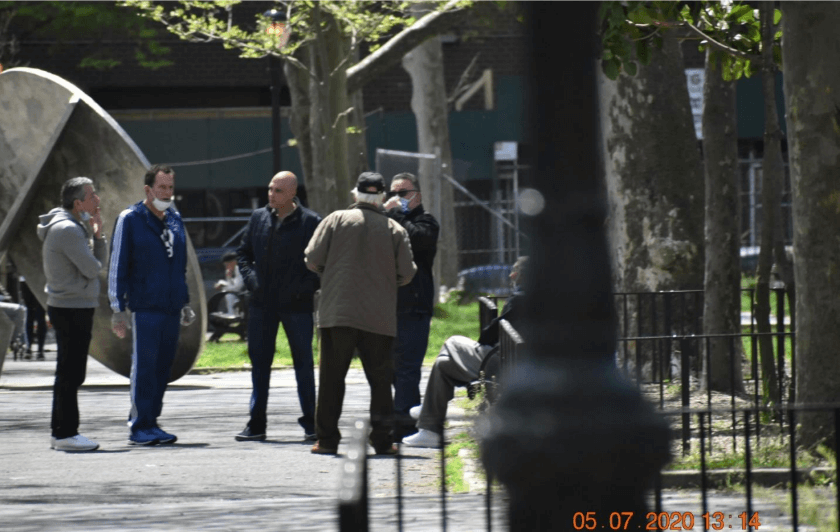
They began tailing him in Brooklyn, photographing him with associates
on 18th Avenue in Bensonhurst, and interviewing confidential sources
about the Gambino soldier.
In one October 1997 report, an FBI agent recorded doing a “spot
check” on a location on 18th Avenue between 72nd and 75th Streets in
Bensonhurst, according to the files. The agent recorded an unidentified
mark walking with Cali before entering the “Point After Sports Bar and
Grill.”
In July of that year, an agent drew up a report titled, “Surveillance
of Frank Cali on 18th Avenue, Brooklyn, NY,” which included photographs
of Cali and several other people as they visited Tony’s Luncheonette in
the neighborhood.
The FBI also listed him as a “recently made member in the Gambino Family” in a March 1997 communication.
A federal grand jury related to Cali was convened in 1998 in the
Eastern District of New York, but charges against him were never
brought, the documents show.
Federal charges for a phone card scam were later filed against John
Gotti Jr., the reputed leader of the Gambino family at the time, but
later dropped by prosecutors.
“I was a victim. I lost a lot of money on that deal,” Junior told The Post at the time.
After his one arrest in 2008, federal prosecutors in Brooklyn
highlighted Cali’s involvement in the phone card scheme in arguing he be
locked up pending trial.
At a detention hearing, prosecutor Joey Lipton told the judge Cali —
who had risen to the rank of captain at the time — had been a successful
criminal because of his ability to hide from the spotlight.
“Cali, like other members of the family, has sworn a blood oath to
the organization to commit criminal activity,” Lipton said. “Cali has
been successful in fulfilling that oath, in large part because he’s been
careful.”
Lipton also alleged Cali had significant ties to mafia members in
Italy, telling the judge that a number of people in his crew at the time
had been born in the old country.
Lipton said investigators recorded two Italian mafiosos speaking about Cali in Palermo.
“He’s everything over there,” one of the Italian made men said to the other, Lipton said at the hearing.
In the 2008 case, Cali pleaded guilty to extortion conspiracy and was sentenced to 16 months in prison.
After his release, he continued his meteoric rise in the family,
reportedly rising to the boss in 2015 after the acting don Domenico
Cefalu stepped down.
Cali’s hidden image exploded into international headlines when he was shot and killed outside of his home in March 2019.
The alleged gunman, Anthony Comello, an apparent QAnon conspiracy theorist,
lured Cali outside of his home in Todt Hill on March 13, 2019 by
crashing into the mobster’s parked car, police said at the time.
After a brief conversation between the two, Comello allegedly shot Cali multiple times in the chest, fatally wounding him.
After
a number of bizarre court appearances – including one where he scrawled
the letter “Q” on his hand – Comello was deemed mentally unfit to stand
trial in 2020.
A spokesperson for the Staten Island District
Attorney’s office said in an email Wednesday that they could not provide
any information about the case.
https://nypost.com/2022/09/21/fbi-files-reveal-slain-gambino-boss-frank-calis-rise-to-power/


:quality(70)/cloudfront-us-east-1.images.arcpublishing.com/tronc/3UHZDGBYTBE5LKD7RCLMZ2N5HQ.jpg)
:quality(70)/cloudfront-us-east-1.images.arcpublishing.com/tronc/XGC6RNLFYFCMFNKO66RU6Y6DOQ.jpg?resize=708%2C0&ssl=1)


:quality(70)/cloudfront-us-east-1.images.arcpublishing.com/tronc/SKF3JGJHOJELRJMQTMJCKYWX4E.jpg)
:quality(70)/cloudfront-us-east-1.images.arcpublishing.com/tronc/CBCOXJDYEZEYTDXFA6AA43TCGU.jpg)
:quality(70)/cloudfront-us-east-1.images.arcpublishing.com/tronc/XNY7KI3ZVJA3NAH7GSR3L2D5TY.jpg)