Updated news on the Gambino, Genovese, Bonanno, Lucchese and Colombo Organized Crime Families of New York City.

Showing posts with label Joseph Massino. Show all posts

Wednesday, February 26, 2025

Corrupt Long Island cop worked for the Bonanno family to bust rival Genovese gambling operations


Mob justice is best served cold.

A crooked Nassau County police detective moonlighting as a Bonanno soldier helped fuel a mini-mob war on Long Island — choosing “the crime family over the public he swore to protect,” a court heard Tuesday.

Ex-Det. Hector Rosario conspired to target rival Genovese mafiosos in the feud that spilled out after the organized crime clans struck an unusual agreement to split the proceeds of a gelato shop’s backroom gambling den, according to the feds.

But peace didn’t last and Rosario “sold himself” to the Bonnanos — even staging a fake police raid at a covert casino run by the Genoveses, Brooklyn federal prosecutors said in opening remarks at the alleged dirty cop’s trial.

“He and other men barged in acting like actual police officers, broke a gambling machine and sent a message,” Anna Karamigios, assistant US attorney for the Eastern District, told jurors.

The Bonannos and Genovese – two of the Five Families in the American mafia – generally kept to their separate spheres during the 1980s and into the early 2000s, said a long-time mob investigator.

“There were no beefs and no sit-downs,” the investigator said. “As far as business, there were no major schemes that they worked on together.

“Back then, ‘The Chin’ (Vincent Gigante), the head of the Genovese family, did not respect (Bonanno boss) Joe Messina, so he would have nothing to do with him.”

Now, the expected two-week trial against Rosario — who is charged with obstructing a grand jury probe into racketeering and lying to the FBI — promises to expose secrets of New York’s alive-and-well mob underworld.

Jurors spent the trial’s first day of testimony Tuesday being introduced to a Who’s-Who of wiseguys, from Sal Russo to “Sal the Shoemaker.”

They also learned about a constellation of illegal gambling operations — leading to a sweeping bust in 2022 that rounded up eight alleged mobsters and Rosario, who’s accused of being on the take for $1,500 a month.

“He chose the crime family over the public he swore to protect,” Karamigios said.

The then-detective’s nefarious side gig as Bonanno stooge came in handy for the family sometime around 2012, according to trial testimony.

A former Bonanno soldier — Damiano Zummo, 51 — testified that the family had entered into an arrangement with their Genovese brethren to share profits from Gran Caffe, a gelato shop in Lynbrook that doubled as a covert casino.

The shop had two card tables in the back, along with poker machines in a small room, Zummo, the first witness to testify, said.

The owner originally split profits 50-50 with a Genovese family member, but that arrangement ended when the mobster got sent to prison, Zummo testified.

The Bonannos got involved after the owner sought protection after being beaten up, Zummo said. They reached an uneasy agreement for a 25% each share of profits, effectively making it a joint Bonanno-Genovese mob venture, he said.

The understanding between mob families was that they could not operate competing gambling parlors within a 5-mile radius, Zummo said.

But tensions boiled over when a down-on-his-luck gambler opted to stop patronizing the gelato shop in favor of gambling at Sal’s Shoe Repairs, which was run by Salvatore “Sal the Shoemaker” Rubino, a Genovese mobster, Zummo testified.

The move resulted in the Bonanno family — which was pulling in $10,000 — “losing money,” Zummo said.

He said Sal Russo, a Bonanno, wanted to “intimidate” the Genovese by using Rosario.

“Russo came up with the idea of a fake raid and I was all for it,” Zummo testified.

“For Hector to go in there, to Sal’s Shoe Repairs, and intimidate them in hopes they close down.”

Sal’s Shoe Repair had a card table in the back room with three or four gambling machines, Zummo said.

The fake raid of the shoe repair gambling den didn’t result in any arrests or citations, prosecutors said.

Zummo said that Rosario carried out an aborted raid at a coffee shop with a gambling den in Valley Stream owned by the Gambino family, because it was less than a mile from “Soccer Club,” a Bonanno-operated parlor owned by Sal Russo.

But the would-be raid went south when Rosario and a crew of a few guys weren’t able to get inside the gambling den, Zummo said.

The reason: it had a buzzer and they weren’t allowed inside, Zummo testified.

Rosario liked “again, and again” when pressed by the FBI during interviews in 2020, claiming he didn’t know anything about gambling dens, prosecutors said.

He also pulled information of a rival mob member from a law enforcement database and gave it to the Bonanno family, according to prosecutors.

The Bonanno family paid Rosario $1,500 per month during the time of the raids, which went on for a “few months,” according to Zummo.

Zummo testified that Rosario also tipped him that he was under investigation and to “stay off the phone” because “the feds are listening.”

He testified that he considered Rosario to be a “street guy.”

“Street guy means he’d break the law if he had to,” he said.

Zummo was arrested in 2017 alongside Russo in a drug-trafficking scheme that involved a $40,000 sale of cocaine in a Manhattan gelato shop.

Both are cooperating with the feds in the case.

Rosario’s defense attorney Lou Freeman told jurors that the former cop had made a false statement to authorities, but it was about a marijuana grow house in Queens that wasn’t material to the case.

He also argued that witnesses who are convicted of racketeering, distribution of cocaine and other serious crimes would be testifying against Rosario, who has pleaded not guilty and is out on bail.

“Each of these witnesses were in organized crime,” he said.

Sal Russo, who was once a “close friend” of Rosario’s, had put the former Nassau cop on the feds’ radar in hopes for a more lenient sentence, Freeman said.

“You will hear Sal Russo made up information about Hector Rosario to get one more notch on his belt because more notches on a cooperating witness’s belt mean less jail time,” Freeman said.

The feds confirmed they will be calling three cooperating witnesses during the trial, which resumes Wednesday.

https://nypost.com/2025/02/25/us-news/crooked-ex-li-cop-who-moonlighted-as-a-bonanno-solider-helped-fuel-mini-mob-war-with-rival-genovese/

Thursday, September 26, 2024

Flipped Bonanno Captain dies in Florida while in witness protection


The first domino to fall in the Bonanno crime family was Frank Coppa, a corpulent capo who once survived a car-bomb attack and procured fried chicken for hungry hit men before an execution.

In 2002, he was serving time for securities fraud when he was indicted on racketeering and extortion charges. Facing an even longer prison sentence, he notified the F.B.I. that he wanted to cooperate with the government.

It was the first time a Bonanno member had flipped, violating the mafia’s solemn oath of loyalty, Omertà.

Mr. Coppa’s decision to cooperate with federal prosecutors, knowingly putting his life at risk, led at least 10 other members to do the same and ultimately helped the government convict Joseph Massino, the Bonanno boss, of seven murder charges and immobilize his mafia family.

“Coppa’s cooperation was the first major development in a series of prosecutions which, during their course, resulted in the indictment of virtually every high-ranking member of the Bonanno family,” Amy Busa, a federal prosecutor, wrote in court papers. “Coppa’s cooperation with the government has been truly historic.”

In return, Mr. Coppa was sentenced to time served and entered the federal government’s witness protection program. He died on Oct. 17, 2023, at his home in Sarasota, Fla., according to a death certificate obtained by The New York Times. No cause was listed. He was 82.

His death was first reported last month by “The Sit Down: A Crime History Podcast,” a popular show for aficionados of mafia history.

After Mr. Coppa decided to flip, F.B.I. agents took him to the bureau’s training facility in Quantico, Va., where he spent two weeks explaining the inner workings of the Bonanno family and narrating gruesome details of multiple murders, including two he helped set up.

In 2004, he testified in federal court against Mr. Massino, a close friend whose own rotundity was sneered at in the tabloid newspapers that were feasting on details spilling out of the trial, in Brooklyn.

The Daily News noted that Mr. Coppa had “turned over personal photos of the two fatsos vacationing together in Europe.” The New York Post columnist Steve Dunleavy called Mr. Coppa a “mob turncoat” who “rolled over like a circus dog on a raft of wiseguys.”

Mr. Coppa, known as Big Frank, spent two days on the witness stand describing a world seemingly drawn from a Mario Puzo novel, with characters nicknamed Bobby Wheelchairs, Sally Bagel, Gene the Hat, Patty from the Bronx and Little Nicky Eyeglasses.

At times, it got testy.

“How did you force people to do things, Mr. Coppa?” Mr. Massino’s defense lawyer asked, according to the trial transcript. “You don’t look like such a tough guy.”

“I don’t?” Mr. Coppa replied.

The proceedings were also banal, harrowing and surreal — sometimes all at once.

One afternoon in 1978, Mr. Coppa testified, he left a bagel shop he had invested in and tried to get into his car.

“What happened?” a prosecutor asked.

“I got blown up,” Mr. Coppa said.

“How were you injured?” a prosecutor said.

“Severely,” Mr. Coppa said. “Blown apart.”

He spent several months in a hospital recovering. He suspected that the bomber was another underworld figure with whom he was having a dispute. Mr. Coppa sent several Bonanno members to kill the man. They shot him five times in his driveway in Staten Island. He survived.

A few months later, the man called Mr. Coppa.

“He was trying to see if I did it,” Mr. Coppa testified. “I told him, ‘Don’t worry about it, go about your life.’” He added, “I wasn’t sure if he did it, and I was sorry that I had him shot.”

Mr. Coppa also detailed his role in the death of Dominick Napolitano, a Bonanno member, known as Sony Black, who was executed in 1981 for unwittingly connecting the family with an undercover F. B.I agent, Joseph D. Pistone, who used the alias Donnie Brasco. Mr. Pistone later wrote a book about that experience and was played by Johnny Depp in “Donnie Brasco,” a 1997 film adaptation.

The night of Mr. Napolitano’s murder, Mr. Coppa testified, he had bought fried chicken for the hit men as they prepared for the execution, at a Bonanno member’s house in Queens.

It happened while Mr. Massino waited in a car nearby. Mr. Coppa, guarding the home’s front door, let Mr. Napolitano in for a prearranged meeting in the basement. Mr. Coppa testified that he heard three shots soon after they descended the stairs — one, then a pause, then two more. It turned out that one of the assassin’s guns had jammed. The other Bonanno associate finished the job.

“He died like a man,” Mr. Coppa testified.

Though he carried a .38-caliber revolver most of his life, Mr. Coppa was never accused of pulling the trigger in a murder. His toughness, especially when it came to doing time, was questionable. He acknowledged in court that when he went to prison for the first time, in 1992, he cried uncontrollably for days.

Among law enforcement officials, Mr. Coppa was known as a clever wise guy. He made millions of dollars for himself and the Bonanno family in pump-and-dump schemes, boosting the value of penny stocks to quickly turn a profit. He also shook down underworld figures outside the Bonanno family who were engaging in securities fraud.

“He was one of the smartest mob guys you’re ever going to meet,” a former F.B.I. agent involved in the case said in an interview on the condition of anonymity so that he could speak about the investigation. “He understood how to engineer these financial frauds. He was at a completely different level when it came to most of these guys.”

The former agent said he believed that Mr. Coppa had been remorseful.

“One of the reasons he cooperated is that I think he regretted his participation in the violent stuff when he was younger,” the official said. “He lived off that reputation for many years. But he was actually likable in a way.”

Frank Coppa was born on Sept. 11, 1941, in Brooklyn, according to his death certificate, which listed his parents as Michael Coppa and Marianna Mattera.

During his testimony, Mr. Coppa sketched out a blue-collar upbringing. He said his father was a stevedore. As a teenager, Frank waited tables and bagged groceries. His first arrest was when he was 19, charged with burglarizing a clothing store. He later drove school buses, he testified.

Mr. Coppa testified that he met Mr. Massino in 1977 at the Fulton Fish Market, in the Bronx, and that he became a soldier in the Bonanno family not long after, joining a criminal enterprise founded and ruled by Joseph Bonanno for more than three decades until the mid-1960s. The two men became close friends, even vacationing with their wives in Monte Carlo and Paris, where Mr. Massino bought Mr. Coppa rosary beads to carry in his wallet.

Mr. Massino was convicted in the 2004 trial and received two life sentences. Not long after, he decided to cooperate with the government, serving as a prosecution witness against other mafia figures. He was released into the witness protection program and died last year.

Details of Mr. Coppa’s life after working with the F.B.I. are unclear.

During Mr. Massino’s trial, Mr. Coppa said he hoped the government would let him keep about $2 million that he had stashed away, along with several homes and vehicles. It is believed that Mr. Coppa left the witness protection program years ago, when the depleted Bonanno crime family was no longer a threat to his life.

Public records listed him as residing in Sarasota in a high-rise condominium, which his wife, Marguerite Coppa, purchased in 2010 for $457,500, according to the deed.

Information about his survivors was not available.

While on the witness stand, Mr. Coppa testified about his induction into the Bonanno crime family. He was taken to an apartment in Brooklyn, where he waited in a bathroom as the leadership team inducted other new members in the living room.

Soon it was his turn. He joined hands with the leaders.

“What was the oath that you took?” the prosecutor asked.

“Oath of silence,” Mr. Coppa said.

https://www.nytimes.com/2024/09/26/nyregion/frank-coppa-dead.html

Friday, July 12, 2024

Wednesday, January 31, 2024

Thursday, January 25, 2024

Thursday, September 21, 2023

Underworld rejoices as longtime former Bonanno Boss Joseph Massino dies in witness protection program


Joseph Massino, the low-key Mafia boss who stunned the world of organized crime in 2005 when it was revealed he had become a government witness, has died after a short illness, sources close to his family told Newsday.

Massino, once a trim and powerful man who would jump off the Cross Bay Boulevard bridge in Queens and swim for hours, battled a number of chronic health conditions including diabetes and obesity. He was 80 and lived until recently in Ohio. Massino died Sept. 14 at a rehabilitation facility in the New York City area, according to the sources.

Massino’s youngest daughter Joanne, who asked that her last name not be published, confirmed his death but declined to comment further.

Over the years Massino navigated the treacherous world of the Mafia families in New York, all the while running legitimate businesses such as a sandwich shop in Queens, catering firms in Farmingdale and the CasaBlanca Restaurant in Maspeth, which he forfeited after a federal racketeering conviction in 2004.

“He ruled with an iron fist and kept order within the ranks,” said former FBI supervisory special agent Charles Rooney, who investigated the Sicilian faction of the crime family in the famous Pizza Connection drug case.

Through tribute paid to by fellow mobsters along with illegal and legal earnings, Massino amassed a fortune and after his conviction, had to turn over $10 million in cash — some of which he had kept in his Howard Beach home — as well as gold bars and other assets.

Massino actually wanted to cooperate within minutes after a Brooklyn federal court jury found him guilty in July 2004 of racketeering, including the orchestration of six mob murders, as boss of the Bonanno crime family. Massino immediately approached presiding Judge Nicholas Garaufis and said he wanted to cooperate, at which point Garaufis appointed him a special lawyer to negotiate.

After several months, it was revealed that Massino, who faced a federal death penalty trial in a different case, was cooperating against fellow mobsters. In 2005, Massino formally entered the federal witness security program. His life sentence was reduced to time served in 2013.

Born in Queens in January 1943, Massino was one of three sons of Anthony and Adeline Massino and lived close to Maspeth. Massino was an athletic young man who earned a reputation as being a street tough after dropping out of school in the seventh grade.

Massino took a number of jobs, including working as a lifeguard at Atlantic Beach on Long Island. As a young adult, Massino started a coffee cart business, serving businesses in the Maspeth area.

But it was in the 1970s that Massino became associated with Philip Rastelli, who rose to become boss of the Bonanno crime family. After Rastelli went to prison, investigators said his trust in Massino grew.

Massino was inducted into the Mafia around 1977 and became a captain in 1979, according to the FBI. Two years later, in May 1981 according to federal court testimony, Massino helped engineer the killings of the three upstart captains — Philip Giaccone, Alphonse Indelicato and Dominic Trinchera.— suspected of trying to gain control of the Bonanno family.

After Massino served time in federal prison in the 1980s, he was officially anointed as boss of the Bonanno family in 1991 upon Rastelli’s death.

Although Massino was a friend of his neighbor John Gotti, head of the Gambino family, he didn’t emulate his public stance and nightlife. Instead, Massino kept a low profile and closed down mob social clubs to frustrate FBI surveillance. To keep his name out of conversations that could be bugged, Massino asked that fellow gangsters refer to him only by tugging on their ears, a gesture that earned Massino the moniker “The Ear.”

But by 2000, the FBI again focused on Massino. The result was a federal indictment that led to his arrest on Jan. 9, 2003, along with his wife Josephine's brother, Sal Vitale. But soon after, Vitale became a government witness against Massino and testified at the mob boss’s 2004 trial.

After he became a government cooperating witness, Massino helped build a case against his former street boss, Vincent “Vinnie Gorgeous” Basciano. Massino also gave information to the FBI that allowed investigators to dig up the bodies of the captains killed in May 1981.

https://www.newsday.com/long-island/obituaries/joseph-massino-mafia-died-80-maspeth-btvng07p

Tuesday, January 31, 2023

Sunday, November 7, 2021

Wednesday, October 27, 2021

Aging Colombo Boss posts $10M bail while another is denied compassionate release


Andrew “Mush” Russo in 1996.

The wheels of justice spun in different directions Wednesday for a pair of octogenarian Colombo crime family bosses.

Current leader Andrew “Mush” Russo, charged in a lucrative and long-running mob union shakedown, won his freedom with a $10 million bond while his long-imprisoned Colombo predecessor Victor “Little Vic” Orena was denied compassionate release despite his fast-deteriorating health in separate Brooklyn Federal Court rulings.

Russo, 87, secured his home detention from Chief Magistrate Judge Cheryl Pollak in part with properties worth $7 million, although his earliest taste of freedom would be Thursday once the paperwork is complete and a prosecution doctor conducts an evaluation, officials said. Pollak found Russo posed no threat to the community due to his health issues, including some form of dementia.

“If they want to get some more doctors to reach the same conclusion, they’re certainly welcome to do that,” said defense attorney Jeffrey Lichtman. “He’s also been shackled by both ankles to a bed 24 hours a day and the government told the judge that Andrew was receiving ‘excellent around the clock care.’

“That didn’t fly either.”

Mobster Victor Orena leaving 26 Federal Plaza with FBI agents.

Orena, the family boss during a bloody internal family war where 15 people died in the early ‘90s, was kept behind bars by Brooklyn Federal Court Judge Eric Komitee despite the 87-year-old gangster’s myriad health woes — including dementia, Alzheimer’s disease, diabetes, glaucoma and heart problems.

Orena will remain inside the Federal Medical Center Devers in Massachusetts after the judge’s 10-page Wednesday decision.

“A strain of cases ... has emerged in which the offenders’ criminal history is so long, and their victims so numerous, that even serious health conditions do not suffice to merit relief,” the judge wrote. “This case falls squarely in that category.”

One of the those slain during the mob war was an innocent 17-year-old shot six times while working behind the counter of a Bay Ridge bagel shop.

The Orena faction battled forces loyal to then-jailed Colombo boss Carmine “Junior” Persico, with Russo moving into the top spot after Persico’s death in 2019. Orena’s attorney, in a hearing earlier this month, said the deranged ex-boss was now convinced that he was president of the United States.

Russo, under terms of his release, would remain under home detention, GPS monitoring, phone monitoring and a ban on contact with his 13 co-defendants or anyone else affiliated with La Cosa Nostra.

Prosecutors were permitted to have one of their doctors evaluate Russo in hopes the judge will reverse her decision. In court papers opposing his release, the feds cited Russo’s appearance last year at a gathering of the family hierarchy and his hosting of a meeting with two Colombo co-defendants this past March in his Long Island home.

“Releasing the defendant on the terms proposed by defense counsel would return him to his home, from where he carried out much of charged conduct, and give him the full resources of the Colombo crime family,” prosecutors argued in court papers.

In the Orena case, his history of failing health fell far short of swaying Komitee.

“I have considered Orena’s arguments ... (and) I am left with the inescapable conclusion that any sentence short of the life term imposed ... would insufficiently reflect the seriousness of the offense conduct here and fail to provide just punishment,” he wrote.

Orena’s son Andrew said the family’s attorney would appeal the decision, while acknowledging his sickly father was running out of time.

“Yes, he’s in bad shape,” said Andrew Orena. “So we’re forced to do it this way. So we’ll see. We have to push.”

Komitee described Vic Orena as “a singular figure in the annals of the Colombo family” — which traces its roots to the legendary boss Joe Colombo.

“He rose to a leadership role, becoming acting boss in 1988, and his efforts to cling to power triggered a bloody war,” the judge wrote. “Orena oversaw a campaign of violence that resulted in a swath of death and serious injury.”

And he noted the difference between Orena and other mobsters granted shorter sentences despite their roles in organized crime violence, including Colombo capo Greg Scarpa and Bonanno family boss Joseph “Big Joe” Massino.

“These cases generally involved high-ranking defendants who elected to cooperate with the government, at serious risk to themselves,” Komitee found.

https://www.nydailynews.com/new-york/nyc-crime/ny-colombo-mob-boss-orena-compassionate-release-20211027-p4alrthlkbgh7f7rhr2pevs3h4-story.html#nt=pf-single%20chain~top-left-chain~flex%20feature~curated~colombo-212p~P4ALRTHLKBGH7F7RHR2PEVS3H4~1~1~2~5~art%20yes

Wednesday, June 9, 2021

Wednesday, March 3, 2021

Monday, May 27, 2019

Former Bonanno consigliere linked to Mob Wives stars dies at age 78


https://www.nydailynews.com/resizer/Nos0Bb5rAN5OgeWnHDRDlX6YaOc=/800x0/arc-anglerfish-arc2-prod-tronc.s3.amazonaws.com/public/JPWJIB35HJEHVEXZB2C57ZLVYA.jpg
Reputed Bonanno crime family consigliere Anthony Graziano, whose daughter Renee starred on the reality show “Mob Wives,” has died at age 78.
The passing of the Staten Island-born gangster known as “T.G.” was announced Saturday by Renee in a heartfelt Instagram posting. Her sister Jennifer was the creator of the popular VH-1 program that reportedly caused problems for the Graziano patriarch with his organized crime colleagues.
“I can’t believe you’re gone, life will never be the same without you,” wrote Renee. “My hero, my protector, my rock, my dad and the best man in the world ... We sure are gonna miss you ... rest in peace Daddy.”
Graziano, owner of a seventh-grade education, became a well-respected gangster and top family earner who moved up through the Bonanno ranks to capo and then consigliere under boss Joseph "Big Joey" Massino — who eventually flipped and became a federal witness.
In contrast, Graziano’s reputation among his fellow Mafiosi was sterling. A co-defendant, once asked if Graziano could ever turn on his mob compatriots, ridiculed the idea: “Are you nuts? That man is a man and a half.”
https://www.nydailynews.com/resizer/tsUSIwr7MlpsKe_nXID1kuZkQVA=/415x0/arc-anglerfish-arc2-prod-tronc.s3.amazonaws.com/public/M5ABWJ6XVNGOPCSWX35KROGULU.jpg
Graziano was famously ratted out by his son-in-law Hector Pagan, who wore a wire in a case that stuck Graziano with a 19-month prison sentence in 2012.
He previously did time for a 1990 conviction for tax evasion, and served another prison term for a 2002 racketeering conviction.
Graziano’s disdain for his daughters’ television careers led him to stop speaking with them for a period of time until fences were mended. And there were reports that the daughters’ involvement in the reality show led his fellow mobsters to take away many of the father’s organized crime responsibilities.

https://www.nydailynews.com/new-york/ny-20190525-yxbnarzozzhgbdop3oc5hxsvge-story.html

Saturday, May 18, 2019

Mob lawyer gets time served for helping put Vinny Gorgeous away for life


A former mob lawyer who turned canary against Bonanno crime family boss Vincent “Vinny Gorgeous” Basciano was sentenced Friday to time served — three days — by the same judge Basciano once tried to have killed.
Defendant Thomas Lee cried and hugged his attorney after Brooklyn federal court Justice Nicholas Garaufis handed down the sentence.
“Good luck, and have a good life,” Garaufis told Lee, nearly 14 years after the defendant took the stand against Basciano to finger him for racketeering, including acts of murder, murder conspiracy, and solicitation of murder.
Lee admitted to abusing his power as a lawyer to pass messages from acting boss Basciano to the family’s incarcerated official head, Joseph Massino, in 2004 regarding a murder plot.
“I don’t blame my upbringing, I don’t blame my neighborhood, I don’t blame my father’s drug addiction,” Lee told the court Friday, referencing his mob-tinged childhood in The Bronx. “The most important thing is that I’ve broken the cycle.
“The self-inflicted wounds are the worst,” the 51-year-old said. “And the difficulty is, the story I injected myself into is folk, it’s created.”
Lee spent three days in jail, just long enough to be arraigned, in 2005 before being set free on $2 million bond and heading straight into the federal Witness Protection Program, where he remains.
While he had faced between 121 to 151 months behind bars following his guilty plea to a charge of racketeering, prosecutors went to bat for him in a letter to Garaufis, given his testimony at multiple trials.
The judge Friday thanked prosecutor Amy Busa for the submission, which he described as “all these many years later, bringing back these memories I had hoped to forget.”
Garaufis was named on a 2006 hand-written hit-list Basciano passed off behind bars while he was awaiting retrial, after a jury deadlocked on his first trial.
Basciano was eventually convicted on racketeering charges, including acts of murder and murder conspiracy, and is serving life in prison.
Lee declined to comment through his lawyer, Joel Cohen, though the attorney lauded the sentence.
“I think he earned the sentence he got,” Cohen said.

https://nypost.com/2019/05/17/mob-lawyer-turned-rat-is-sentenced-to-time-served-3-days/

Friday, January 12, 2018

Feds bust Bonanno crime family leadership in devastating takedown


https://vignette.wikia.nocookie.net/mafia/images/b/b5/Bonanno-family-christmas-party-1.jpg/revision/latest?cb=20160512215016
The acting boss of the Bonanno crime family and other top-echelon leaders were among 10 mobsters busted Friday on racketeering charges, the Daily News has learned.
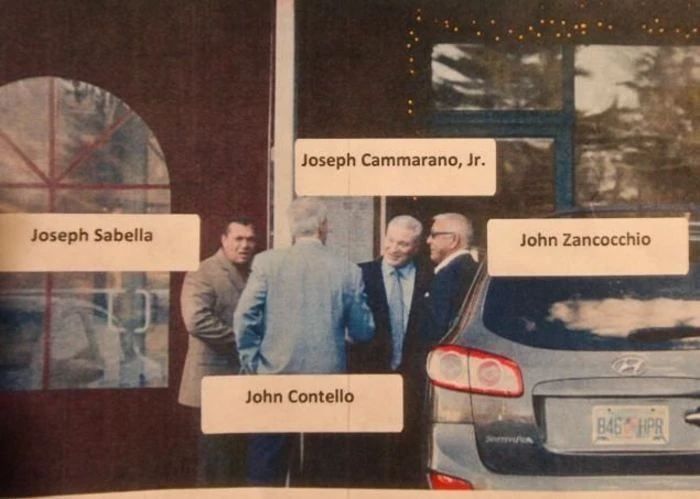
A 16-page federal indictment charged leader Joseph "Joe C" Cammarano Jr. and the rest with a variety of charges, including conspiracy to commit murder, extortion and drug dealing.
Charged along with Cammarano were Bonanno consiglieres John "Porky" Zancochio and Simone Esposito, as well as capos Joseph "Joe Valet" Sabella and George "Grumpy" Tropiano.
The Bonanno family also “met with leaders, members and associates of other La Cosa Nostra Families to resolve disputes over their criminal activities,” the indictment said.
And paranoid family members and associates tried to ferret out possible informants within their ranks — a major concern for the Bonannos.
The mob family was famously infiltrated for six years by FBI agent Joe Pistone, and its boss Joseph "Big Joey" Massino flipped after a 2003 arrest to become the highest-ranking Mafia turncoat ever.
Cammarano, the son of a mob underboss who died in prison, reportedly took over in 2015 as the decimated family tried to rebuild itself.
The Brooklyn native is a Navy veteran who served on a nuclear submarine in an elite patrol unit.
The Manhattan Federal Court indictment comes just two days after five accused Genovese family mobsters — including late boss Vincent "Chin" Gigante's son, Vincent Esposito — were nabbed on racketeering charges.
In the Friday court filing, Bonanno soldier Albert "Al Muscles" Armetta was charged with beating an unidentified victim on Halloween 2015 “for the purpose of gaining entrance to” the crime family.
The 10th defendant was identified as Eugene "Boobsie" Castelle, a Lucchese family soldier who teamed with the Bonannos on “one or more criminal schemes,” the indictment charged.

http://www.nydailynews.com/new-york/nyc-crime/suspected-bonanno-mobsters-busted-racketeering-related-charges-article-1.3753152

Friday, September 22, 2017

Bonanno captain sentenced to six months of house arrest for violating parole restrictions


https://thenypost.files.wordpress.com/2017/09/attanasio.jpg?quality=90&strip=all&w=1033
He got the last laugh.
Bonanno crime-family cap​o Robert “Bobby Ha Ha” Attanasio came out on top Wednesday when a judge sentenced him to just ​six months home confinement for violating the terms of his parole​ when he gabb​ed on the phone with other ​wiseguys.
Prosecutors originally tried to lock up the capo claiming he’d been caught red handed playing in a Staten Island bocce tournament against Gambino ​mobster Louis Vallario.
​But it was actually Attanasio’s namesake son who was entered in the ​M​afia-studded games at Angelina’s Restaurant in June and July 2015, defense attorney James Froccaro told Brooklyn federal court judge Nicholas Garaufis.
“So this is a mistake?” Garaufis asked Froccaro and Assistant US Attorney Nicole Argentieri.
Froccaro nodded as he stood next to his hulking, balding client, but Argentieri refused to admit there’d been an error, saying her office had agreed to not pursue the bocce-related allegations if Attanasio copped to the other violations.
The 70-year-old​ Attanasio ​– who served 10 years behind bars for his role in the brutal 1984 rubout of associate Cesare Bonventre​ ​– admitted Wednesday he’d taken part in some 300 calls with former prison pals Vincent “Vinny Goo” Caroleo and Frank “Meatball” Bellatoni.
The convicted wiseguy is not allowed to associate with other mafioso after he was imprisoned in 2006 alongside his brother, Louis “Louie Ha Ha” Attanasio and capo Peter “Rabbit” Calabrese for Bonventre’s murder.
Bonventre’s hacked up remains were found pickled in steel drums secreted away in a New Jersey glue factory after mob boss Joe Massino ordered the hit.
Froccaro tried to convince the court Wednesday that his client’s admission didn’t mean he was turning over on Caroleo or Bellatoni, and had no personal knowledge they were mobbed-up.
“I think that’s a distinction that only matters to a certain segment of people,” Argentieri said dryly.
Garaufis wasn’t buying it either.
http://image.silive.com/home/silive-media/width620/img/latest_news/photo/23454841-mmmain.jpg
“If someone’s name is “Vinny Goo,” or “Vinny Collision,” or “Meatball,” frankly, based on my extensive experience in organized crime cases, these are the kinds of nicknames given to people in the cosa nostra,” he shot back. “I don’t know Vinny Goo. I don’t know Meatball.”
Yet Argentieri and Garaufis suspended their disbelief, and accepted Attanasio’s rat-proof admission, in which he only said: “I had contact with individuals whom the government had alleged were associated with organized crime.”
Froccaro asked Garaufis for home confinement, arguing the men only contacted his client when they learned he had cancer.
“It was just stupid,” the lawyer said.
“I don’t know that there’s an exception for prison for stupidity,” Garaufis responded, noting Attanasio’s wife had also “accused her husband of stupidity” in a letter to the court.
But the argument worked, and the judge let Attanasio off with a warning, 6 months home detention, and 2 years post-release supervision.
“Stay off the phone with anyone who isn’t a close relative,” Garaufis ordered. “Or your priest.”

http://nypost.com/2017/09/20/bonanno-capo-dodges-bocce-bust/

Sunday, July 2, 2017

Loyal Bonanno mobster was shelved after daughters made reality tv show


https://upload.wikimedia.org/wikipedia/commons/f/fb/AnthonyGraziano_Massino.jpg
The warden and some guards were shaking prisoners down as they left the chow hall at FCI Loretto, a federal prison in Pennsylvania, when Anthony “TG” Graziano sauntered by with fellow mobsters in tow. “If I were the warden,” Graziano said to his buddies, “I wouldn’t have the hacks out here searching prisoners for food.” His minions — I was among them — laughed while Graziano glared at the warden. “What the fuck am I saying?” he continued. “I’d never be a fucking warden anyway.” They then walked off as other prisoners marveled at Graziano’s nerve.
Known as the ultimate stand-up guy within the mob, this tough-talking mafiaso was respected for his nerve and his loyalty. He did his time, twice, but didn’t become a household name for faithfully following the code of omertà. Instead, Graziano shot to fame when his daughters aired the mob’s dirty laundry on TV.
Graziano was born in the 1940s and is still feared in his Staten Island neighborhood. An old-school hoodlum from the start, the stocky and brutish kid — who never made it past seventh grade — seemed to wear a permanent smirk. And it wasn’t long before he got involved in the neighborhood business, climbing the ranks of the Bonanno crime family and becoming a capo by the 1980s.
TG paid the price for his daughters’ sins.
Larry McShane, author
One of the guys in his crew, John “Porky” Zancocchio, was the bookmaker who took bets from Pete Rose. Zancocchio was under the notorious Dominick Napolitano, aka Sonny Black, until Napolitano was killed in the 1981 Donnie Brasco fallout. Porky was Graziano’s son-in-law, married to his daughter Lana, and Graziano’s other daughters, Jennifer and Renee, also married Bonanno mobsters, Christian Ludwigsen and Hector Pagan. With Graziano raking in cash from Zancocchio’s bookmaking, his daughters were mob royalty who never wanted for anything.
By 1990, Graziano had landed in prison, sentenced to five years and a $250,000 fine after pleading guilty to a tax-evasion charge for hiding his assets in other people’s names. When explaining to the court what he did for a living, Graziano said, “I was a broker… I put two people together.” He was released in 1993, resuming his role as a capo and eventually rising to the position of consigliere in the Bonanno crime family.
In that position, Graziano, then 61, had “access to the full resources of the Bonanno crime family, which includes more than 100 soldiers and countless associates who make money through crime and who are capable of extreme violence,” according to prosecutors in 2002. They charged Graziano with ordering the murder of two Colombo crime family associates who shot up his Staten Island topless bar in 1994. Those hits were called off after a sit-down with the Colombos, but Graziano ended up pleading guilty to racketeering charges, including conspiracy to murder, cocaine distribution and loan-sharking.
He was sentenced to just 11 years because of health concerns, and a smiling Graziano reportedly told the prosecutor, “I wish I was a little younger. I would have fought this case.” “TG is as old-school as they get,” says Scott Burnstein, author of Motor City Mafia: A Century of Organized Crime in Detroit. “He’s not a New Millennium mobster, someone who courts the limelight or wants attention on social media. He goes all the way back to Joe Massino’s height of power, when he was the most powerful godfather in New York City.”
Graziano Sisters
Lana, Renee and Jennifer Graziano

It was during this prison stint that Graziano’s daughter Renee rose to fame as the star of the hit VH1 series Mob Wives. “Graziano’s name really became more widely recognized because of his daughters,” says Christian Cipollini, author of Murder Inc. But the show, created by her sister Jennifer, embarrassed Graziano, who hated how his daughters were exploiting the organization he’d dedicated his life to honoring. When he got out in 2011, he refused to appear on the show. To make matters worse, Renee’s then ex-husband, Pagan, secretly recorded Graziano and other Bonanno members as they planned to collect an illegal $150,000 gambling debt, leading to the 72-year-old gangster being indicted again.
Due to Pagan’s informant status and the case being broadcast on Mob Wives, the judge granted the jury partial anonymity. Graziano was sentenced to 19 months for his role, but the Bonanno family leaders were furious that their business had been aired in public.
“TG paid the price for his daughters’ sins,” says Larry McShane, author of Chin: The Life and Crimes of Mafia Boss Vincent Gigante, noting how the crime family’s leaders stripped him of his senior role. “The longtime mafioso suddenly found himself with no rights or responsibilities within the Bonannos.”
Upon his release in 2013, Graziano’s lawyer told the press that reports of the mobster being upset with his daughters about the show was old news. Still, says Cipollini, it’s “ironic that the daughters of this old-school mobster, the ultimate stand-up guy, created and starred in this Mafia reality series.” A fact that he says Graziano will never live down.
Efforts to reach Graziano through his lawyer and family for comment were not fruitful.

http://www.ozy.com/flashback/the-mob-boss-whose-daughters-betrayed-him-by-starring-on-reality-tv/78747

Tuesday, May 9, 2017

Five myths about the mob


The Tribeca Film Festival ended last month with screenings of “The Godfather” and “The Godfather: Part II.” The purpose was to celebrate the 45th anniversary of the first film, which pumped new life into a genre that had dominated the movie industry in the 1930s. Released at a time when the American Mafia was losing its hold on the underworld, the movies offered a romanticized version of “the life,” a version that celebrated “men of honor” and omerta. In many ways, the movies have served as training films for second- and third-generation Italian American gangsters, who moved from the urban centers of their immigrant grandparents to homogenized suburbs where Sunday dinner is served at the Olive Garden and espresso comes in four flavors at Starbucks. The movies have also reinforced several myths about the Mafia that, ironically, the actions of those in the next generations quickly dispelled.

Myth No. 1
The Mafia doesn’t deal drugs.

In “The Godfather,” Michael Corleone became a gangster after his brother Sonny was brutally slaughtered on the causeway in a dispute over drugs. Don Vito Corleone’s avowed opposition to narcotics trafficking helped create the perception that drug dealing was against the rules. Testimony at real-life mob trials reinforced that canard. “Our policy was against drugs,” mobster turned government witness Salvatore “Sammy the Bull” Gravano said while testifying against mob boss John Gotti in 1993.

The reality is that as far back as Lucky Luciano, the mob has been in the drug business. In 1959, Vito Genovese — who gave his name to one of the five New York families — was imprisoned on drug charges, as was his low-level crime family soldier Joe Valachi. Drugs have generated billions of dollars in income for the mob over the decades. The “Pizza Connection,” for instance, was a Sicilian Mafia heroin ring that dominated the trade in New York and other East Coast cities between 1975 and 1984, bringing an estimated $1.6 billion worth of heroin into the United States, according to federal authorities.

FBI documents do indicate that bosses such as Paul Castellano and Vincent “the Chin” Gigante in New York and Angelo Bruno in Philadelphia banned members of their organizations from getting involved in narcotics. But that wasn’t based on a moral opposition to drug dealing. Rather, it stemmed from the realization by those bosses — who already had more money than they could count — of the tremendous legal jeopardy that came with narcotics as the federal government amped up the war on drugs in the early 1970s. And gangsters have testified that bosses such as Gotti, who banned narcotics, still knowingly accepted tribute payments from underworld drug dealers. The hypocritical message: Don’t deal drugs, but if you do, I get a piece of the action.

Myth No. 2
Omerta, the code of silence, is a sacred rule.

The idea that the Mafia’s code of silence is unbreakable is a centerpiece of pop culture about the mob, in movies, books and TV shows.

In reality, that code was broken decades ago, when Valachi, the Genovese crime family associate, told a Senate subcommittee in 1963 that the syndicate called itself “Cosa Nostra,” or “Our Thing.” Over the next 20 years, a half-dozen made members, including Angelo Lonardo in Cleveland, Aladena “Jimmy the Weasel” Fratianno in Los Angeles and Vincent “Fat Vinnie” Teresa in Boston, became government cooperators. By the late 1980s, omerta was shattered. In city after city, members of the mob began to realize that they could get out from under their criminal problems by cutting deals with federal prosecutors and heading for the witness stand.

In part, this was a result of the Americanization of the Mafia. Doors that had been closed to Italian immigrants in the 1910s and 1920s because of prejudice and bigotry were kicked open two generations later. Today, the best and the brightest in that community are doctors, lawyers, educators, entertainers, scientists and judges. Many of those who now make the Mafia a career choice are driven primarily by economics. These mobsters, unlike earlier generations, never embraced Cosa Nostra as a way of life. For them, it was a business, a way to make money. And when they found themselves under indictment and facing 20 years to life, they made a business decision: How do I cut my losses?

Myth No. 3
The Mafia’s initiation rite is a secret ceremony.

For years, the rite of passage into a Mafia family — known as a making ceremony — was a closely guarded secret. The formal ritual was sacrosanct and seldom discussed, even among members of the crime families. “Once a bullet leaves that gun, you never talk about it,” mob boss Joseph Massino said of an oath he took at his initiation ceremony in 1977.

Of course, Massino said this from the witness stand in 2011 after becoming a government informant, despite the vow he had taken. He joined an ever-growing list of “men of honor” who have openly discussed — usually in courtrooms, but also in books and in television interviews — the secret rite. Today, accurate reenactments can be seen in mob movies, and FBI documents provide detailed accounts of the process. The ceremony usually takes place before a celebratory dinner and is conducted by the boss or the underboss of the crime family. It begins with a formal, almost Baptismal-like questioning of the candidate, whose trigger finger is pricked with a pin. The blood is then wiped on a religious card depicting a saint. The card is crumpled, cupped in the initiate’s hands and set on fire, while the inductee swears an oath to live and die for the crime family, pledging to “burn like this saint” if he betrays anyone in the organization.

The FBI secretly recorded one ceremony in 1989 by planting electronic listening devices in a home in suburban Boston where members of the Patriarca family were to be made. A year later, a New Jersey mob figure who was cooperating with the state police wore a body wire to his own initiation. The mobster, George Fresolone, later co-authored a book titled “Blood Oath.” After the fact, Mafia leaders ruled his ceremony invalid, even though four of the five initiates that day had no idea what Fresolone was up to.

Myth No. 4
Anyone who testifies against the Mafia will be killed.

Joe Pistone, the FBI agent who spent six years undercover as Donnie Brasco, building cases and then testifying against the mob, put it best in a 1997 Washington Post interview: “What concerns you is the cowboy, y’know? Somebody who wants to make a name for himself within the mob.” Pistone’s comments came in response to reports that the mob had put a $500,000 contract on his head. Murder is the tool used to enforce the code of conduct in the underworld. Pistone, as Donnie Brasco, had violated that code.

But the Witness Security Program means it’s safe to break with the Mafia. Cooperating witnesses and their families have an opportunity to walk away from the life. Run by the U.S. Marshals Service since 1971 and commonly but incorrectly referred to as the Witness Protection Program, the service provides relocation, a new identity and a financial stipend to help a witness get reestablished in another part of the country. The program has set up new lives for more than 8,600 witnesses (not all of them Mafiosi) and 9,900 of their family members.

The stipend doesn’t last forever — it usually ends after about a year. The downside, and one reason some cooperators eventually opt out, is that witnesses and their families can never return to visit with friends and relatives they have left behind, a hardship that many find too difficult.

Myth No. 5
The Mafia never interacts with other organized-crime groups.

Most film and TV depictions of the Mafia show it operating completely on its own. And indeed, when they were the big dogs in the game — from the late 1940s through the 1970s — Italian American Mafia organizations rarely interacted with other criminal groups. The one exception was an occasional overlap with the Sicilian Mafia, but then they were criminal cousins whose roots went back to the same family tree.

Today the American Mafia, while still a player, is no longer the monolithic underworld power that it was in the days of Luciano and Al Capone.

Michael Franzese, a Colombo family capo, described his dealings in the 1980s with Russian mobsters in a multimillion-dollar gasoline tax fraud scheme this way: “The Russian mob from Brighton Beach in the gas business — the best partners I ever had.”

Mafia figures in various cities have been linked to the methamphetamine trade with members of the Pagans motorcycle gang. And leaders of the Lucchese and Colombo crime families dealt on a regular basis with Leroy “Nicky” Barnes , a notorious heroin trafficker out of Harlem.

At the end of the day, the Mafia isn’t about pride, it’s about money — how to get it, how to keep it and how to make more of it.

https://www.washingtonpost.com/opinions/five-myths-about-the-mafia/2017/05/05/f4075da8-306c-11e7-9dec-764dc781686f_story.html?utm_term=.d60801245fa1

Friday, November 25, 2016

Is the American mafia making a comeback?


When Selwyn Raab first published his 765-page jeremiad Five Families: The Rise, Decline, and Resurgence of America's Most Powerful Mafia Empires, the year was 2005 and the Mob was, in Raab's words, "a crushed colossus." Decades of indictments brought under the RICO law had vanquished even the most fearsome mobsters; Bonanno crime boss Joseph Massino had just flipped sides for the Feds the year before, and two years prior to that, John "The Teflon Don" Gotti had died a lonely death in a Missouri prison hospital far from the streets of New York.

The book, which drew from Raab's four-decade career investigating the Mob for the metropolitan desk of The New York Times, has since been hailed as the definitive account on all things Cosa Nostra, complete with painstakingly detailed family trees and whole appendixes dedicated to things like "Mafia Boss Succession." (Raab later became a consultant for AMC's 10-part series The Making of the Mob, among others.) Yet despite the prevailing belief that the Mob had been defeated – and the fact that Raab himself had spent nearly 700 pages illustrating the elaborate terms of this crushing defeat – he devoted the last 20 pages to the likelihood of the "resurgence" referred to in its lengthy subtitle.

"This [was] a stretch," chalked up to "an apparent attempt to buoy [the book's] relevance," decided Bryan Burrough in the Times' original 2005 review. Most in New York would've agreed with him. But Raab, in all his expertise, had the foresight that many at this time did not. He believed the September 11th attacks four years earlier had so dramatically shifted the priority of the FBI's New York bureau – the largest in the nation – from organized crime to homeland security, that the mafia would be poised for a comeback.

"The Mob was on the ropes and really needed only one or two more crushing blows before the FBI could really turn these people into old street gangs," says Raab. "That changed after 9/11."

He was right. Even fictional mobsters like Tony Soprano got a reprieve when the FBI agent who had tailed him for five seasons, Dwight Harris, was reassigned to an anti-terrorism case in Pakistan after September 11th — and was kept from his original pursuit of the mob boss even after returning to the U.S. ("That job you got now must be depressing," Tony's nephew Christopher tells Harris. "How goes the war on terror anyway?")

And so the mafia has been able to gain ground and even resurface from time to time for the kind of public spectacle that once was commonplace. In 2011, the bureau made the largest bust in U.S. history, arresting 127 people (more than 30 of them "made men") on charges ranging from narcotics trafficking and extortion to murder, proving the families are still out there. And just this summer, the Feds busted an operation coined the "East Coast La Cosa Nostra Enterprise" which produced 46 arrests and saw an elaborate crime ring, led by an ex-Philadelphia Mob boss, extending from Massachusetts all the way down to south Florida.

Ten years have passed since Raab, now 82, published his legendary tome. This year, he decided it was time to give Five Families an update for the modern age with an anniversary addition that clues readers in on recent developments. Rolling Stone talked to Raab to hear what the Bonanno, Genovese, Gambino, Colombo and Lucchese families are up to in 2016.

What made you want to revisit this book?

Just the survival of these guys, it's amazing. They have more than nine lives, especially in New York. It was obvious that a lot had changed over 10 years and that the book needed updating. Everyone is always writing obituaries on these guys, especially after Gotti was convicted, but they're always wrong.

Just how big a factor was 9/11 in helping these guys survive?

A major, major factor. Priorities for law enforcement are always shifting, but until 9/11, they were doing so well. The FBI also had the buildup of expertise by having people who really knew what they were doing, so in terms of shift emphasis, there's no question it was a reprieve. There were two major interests or priorities for the New York bureau since the beginning of the Cold War: one was counterespionage, the other was organized crime. But all that changed after 9/11. As an example, combined FBI, New York Police and some other organized crime task forces in the New York area went from 300 or 400 agents, down to 20 or 30. When you don't have the personnel, you're not going to have the indictments or convictions.

Will the FBI's focus ever shift back to the Mafia?

I'm no soothsayer, but it's certainly not a priority now. The scare today, justifiably, is from terrorism, not from the Mafia. You can see that in politics, in the election, and every time there's another attack like San Bernardino or the recent bombing in New York – but when you leave [Mafia members] alone, they recoup. And that's always been the problem. They have an organizational framework such that makes it so it doesn't matter if you take out the leader. It's not like drugs or even bank robberies where if you take out the leader, the operation is gone. They're all replaceable. Somebody moves in to continue the operation – and I thought that this East Coast cooperative, where they were working from Massachusetts all the way down to Florida, was pretty good evidence of that — and the Mafia is still effective and still making inroads.

You write that the Mob has become a "perennial favorite theme for the entertainment industry." How has this helped them in the modern age?

There are an immense amount of mafia groupies. There's a perverse aspect to this because it gets kids and young people interested in this feeling that [Mafia members] lives are glamorous and a way of beating the system. Hollywood and TV don't dismiss them as venal or pernicious. I think for very vulnerable people you get this vicarious kick that there's something to this life. Part of it comes from this anti-establishment thing. John Gotti personified this, that by being anti-establishment, anti-government you could somehow succeed in life and be envied. Look at Gotti's grandson's wedding last year; he collected two million dollars and the place was swamped with people giving him gifts. [The entertainment industry] turns these people into icons and interesting characters who are anti-society. It doesn't make them look like they're token bad guys.

A great example was Sammy "The Bull" Gravano; when he saw The Godfather he was in his late teens and he said it made him feel proud to be an Italian and to join the Mafia. And that movie is repeated endlessly. What The Godfather also does is establish that there is good mafia and bad mafia by essentially showing a white hat mafia that was opposed to the introduction of narcotics, which was a total lie and mischaracterization. But the point was there were still Mafiosi who were doing good work, and that there were traditions that were virtuous. This helps them.

What role has the Internet played in the resurgence of the Mob?

You have to remember one thing — historically the Mafia is a carbon copy, or a mirror of American capitalism. The Internet is an important tool for the business and a lot of them use it for Internet gambling. And why not? People aren't going to bookies the way they used to, they couldn't compete by just having some old fashioned bookmaking with some guy with a telephone, and now that you can do it on the internet, they're taking it over. It's big, it's a lot of money, and a lot that is transacted offshore so it's easy to do and you don't have to worry about it. They're modern, they know what works. I thought one of the funny things about that East Coast cooperative, when they were caught, they were selling Viagra because there's a big market for it — anything that works. Look, they're not brilliant business people, they've never been for the most part; all they do is adapt or steal ideas, but one of their effective messages is that they can break your knee caps.

You write that in order to "counter defections," newer Mafiosi have "initiated savage relations including murdering relatives of traitors." What can you tell us about that?

The long established rule was that anyone who was a civilian — not implicated in mafia activities — was immune. One of the reasons that's changed is because of these so called "Zips." That's a nickname for Sicilian newcomers who are not members of the Sicilian mafia but recent immigrants, and they've pretty much taken over the Gambino family. And one of their effective methods [in the old country] was that if you became a rat or you in any way betrayed the Italian or Sicilian mafia, it wasn't just you, but anybody in your family could be victimized. The Americans have now also taken that over and spread the word. You can't pinpoint this practice down to one year, but "recently" would be the best way of describing when it began. But the point is, very simply: it's a method to prevent people from becoming informers and betraying the Mafia. There's stuff on tapes in which they talk about it – "If my kids have to suffer, why shouldn't the rat's kids have to suffer?" Stuff like that. It's an effective tool, and again, they're still getting reinforcements, they're shipping more blood over from Sicily and Southern Italy.

What does it mean now that the Mafia, for the most part, live in the suburbs and not the inner cities?

It's demographics. Most of the old Italian-American neighborhoods no longer exist, so mafia members, like everybody else, are now living in the suburbs. And there's money to be made there. Besides that, the law enforcement there traditionally was never looked upon as a major threat, so it's easier for them. And now that they've moved there, that's where they want to operate. The market for traditional mafia bread and butter ideas – gambling, drugs, extortion – is there too, and so is the constituency. Little Italy, where you used to have all the social clubs, is nothing more than a collection of restaurants. Same thing in Bensonhurst [Brooklyn]. They no longer live there and don't have to operate there.

But the big threat with the Mafia moving into the suburbs is that you need to make sure they never get so large again that they have political influence. That is the scariest aspect. They get the money, and then they get the influence. They can fix elections. They get lawyers. They get judges. They were so influential in politics and the court system and with that influence they could fix elections. Even as well into the latter part of the 20th century. It is going to be hard for them [to ever return that level of influence]. It took the Mafia years in American to learn how to do that. They didn't start off with political clout, but they did develop it later on – there's no question about that.

http://www.rollingstone.com/culture/features/is-the-american-mafia-on-the-rise-w451888

Thursday, January 21, 2016

Bonanno crime family ends 2015 with Staten Island Christmas party


The Staten Island shindig, at Bocelli Restaurant on Hylan Blvd., was mandatory for crime family members.
It was a “family” Christmas.

The newly minted Bonanno boss Joseph Cammarano Jr., hosted the crime family's annual Christmas party at an Italian restaurant on Staten Island that was voted one of the best eateries in the city by the Zagat guide.

The six-hour food fest was held from 11 a.m. to 5 p.m. on Dec. 16 at Bocelli Restaurant on Hylan Blvd. under the watchful eyes and cameras of the FBI and the NYPD, according to papers filed in Brooklyn Federal Court.

It was mandatory attendance for the crime family's administration, which included reputed consigliere Anthony Rabito and more than a dozen capos and soldiers, the court filings say.

The Old World-style restaurant is located in a strip mall, but the Zagat guide praised the upscale food at Manhattan prices.

At the Christmas party, underlings gave family boss Joseph Cammarano Jr. envelopes stuffed with cash.

A Mafia family Christmas party is held so the mob minions make a pilgrimage to the boss and give him an envelope stuffed with cash.

Former boss Joseph Massino used to hold the party in his restaurant, Casablanca, in Queens.

Cammarano, 56, controls the family's "day-to-day criminal activities," according to court papers.

Cammarano's promotion to acting underboss and street boss, exclusively reported Monday in The Daily News, is a sign that the beleaguered family is trying to rebuild after the prosecutions and defections of its members in recent years.

Bocelli's owner did not return a call seeking comment about the Christmas party.

http://www.nydailynews.com/new-york/nyc-crime/bonanno-crime-family-si-christmas-party-article-1.2503900